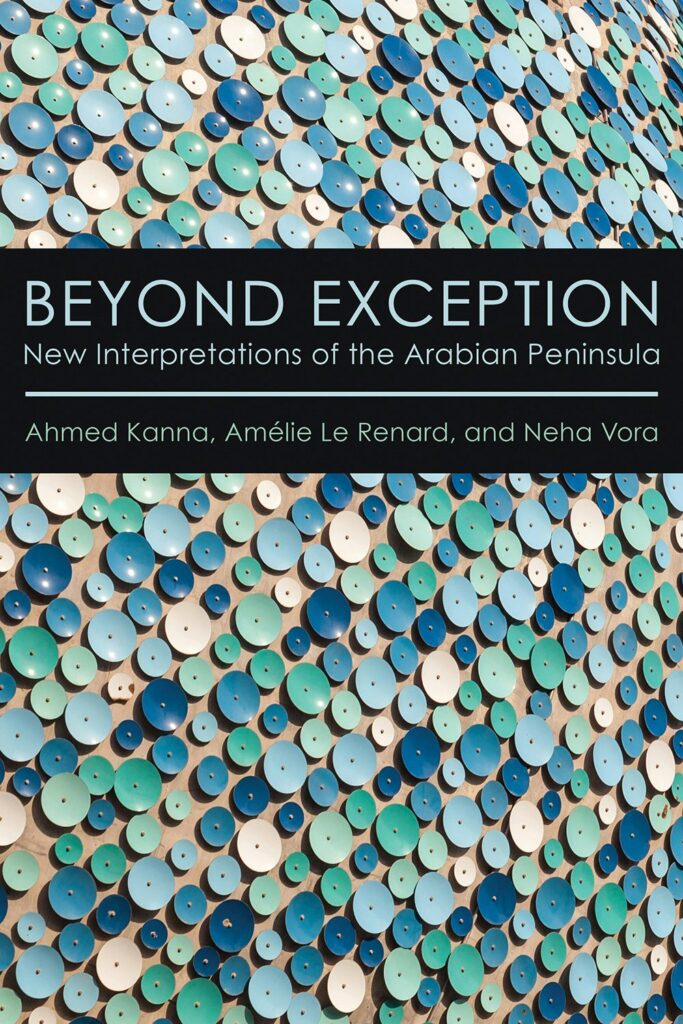
Beyond Exception
New Interpretations of the Arabian Peninsula
Ahmed Kanna, Amélie Le Renard and Neha Vora
Cornell University Press, 2020 · English
Three anthropologists reflect on fieldwork in the Arabian Peninsula and on the exceptionalist ways in which the region and its people are represented.
Ahmed Kanna, Amélie Le Renard and Neha Vora have each done fieldwork in the Arabian Peninsula for close to twenty years, and all three have repeatedly met accounts that treat the region, its people, its governments and its customs as exotic or exceptional. The book grows out of these encounters. It asks what such exceptionalism achieves, who uses it and to what end, and how it feeds the power relations in the societies they study, and it traces these habits of description back to colonial thinking that survives in anthropology and sociology. The authors ask how Middle East studies, and research on postcolonial societies and global capitalism elsewhere, would look if the Peninsula stood at the centre rather than at the margins, and argue that ending its exceptional treatment can help decolonise the production of knowledge.
- Subjects
- Knowledge production
- Discipline
- Anthropology
- Period
- Since 1979
Details
- Publisher
- Cornell University Press
- Published
- August 2020
- Pages
- 162
- Format
- Hardcover
- Language
- English
- ISBN
- 978-1-5017-5029-8
Contents
- Introduction: Ethnography from the Exceptional to the Everyday
- 1. Space, Mobility, and Shifting Identities in the Constitution of the “Field”
- 2. How Western Residents in Riyadh and Dubai Produce and Challenge Exceptionalism
- 3. Anthropology and the Educational Encounter: Archival Logics and Gendered “Backlash” in Qatar’s Education City
- 4. Class Struggle and De-exceptionalizing the Gulf
- Conclusion: Centering the Arabian Peninsula, Decolonizing the Academy