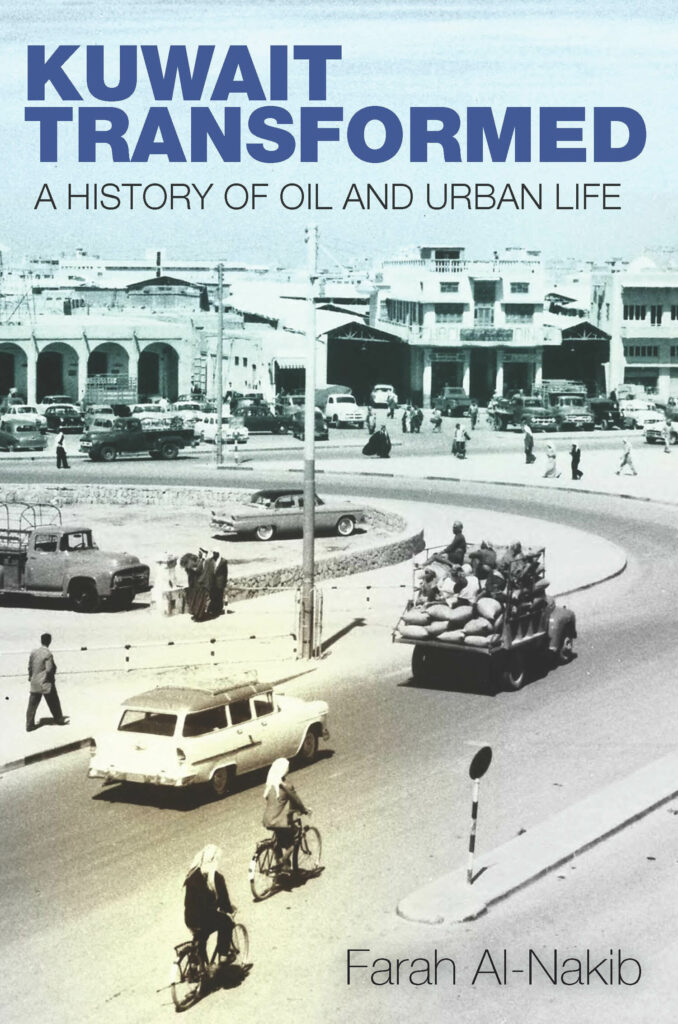
Kuwait Transformed
A History of Oil and Urban Life
Farah Al-Nakib
Stanford University Press, 2016 · English
A history of Kuwait City from its founding in 1716 to the twenty-first century, tracing how oil-era planning reshaped its urban and social life.
In the mid-twentieth century Kuwait City became the first Gulf city remade by oil, and its change from a compact town of mudbrick courtyard houses, where people moved about on foot, into a city of suburbs, marble façades and wide highways became a story repeated across the region. Farah Al-Nakib follows the city from its settlement in 1716 to the present, with the discovery of oil as the hinge between old and new, and studies how the shape of the city, everyday routines and social relations changed together. She argues that decades of planning, suburban expansion and privatisation wore away a once open and tolerant urban society and left insularity, xenophobia and division in its place. Her conclusion is not a lament for a lost town but a call for a ‘right to the city’: the claim of every resident to use and shape its spaces.
- Subjects
- Oil and energy, Urban studies
- Discipline
- History
- Period
- 18th century, 1900–1979, 19th century, Since 1979
Details
- Publisher
- Stanford University Press
- Published
- April 2016
- Pages
- 296
- Format
- Paperback
- Language
- English
- ISBN
- 978-0-8047-9852-5
Contents
- Introduction
- 1. Pre-Oil Urbanism
- 2. Port City Life
- 3. A Cosmopolitan Community
- 4. Oil-Era Modernization
- 5. The Move to the Suburbs
- 6. The Privatization of Urban Life
- 7. The De-Urbanization of Society
- 8. The Right to the City