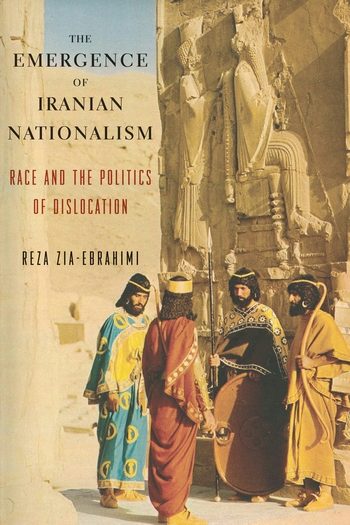
The Emergence of Iranian Nationalism
Race and the Politics of Dislocation
Reza Zia-Ebrahimi
Columbia University Press, 2016 · English
A history of the racialised, anti-Arab nationalism that took shape in late Qajar Iran and became the official ideology of the Pahlavi state.
Reza Zia-Ebrahimi studies a set of ideas that has dominated modern Iranian identity: that Iran is a primordial nation with an uninterrupted history of 2,500 years, that its essence lies in a pre-Islamic golden age, that its decline was caused by Islam imposed by the Arabs, and that Iranians are Aryans, kin to Europeans. He calls this ideology ‘dislocative nationalism’ and argues that it is modern, formed in the late Qajar period between the 1860s and 1890s, and drawn from European Orientalism and race theory rather than from local traditions. Under the Pahlavis it became state ideology, spread through national curricula of history and geography. GlobIS Review discussed the book in its Persian translation by Hasan Afshar (Nashr-e Markaz).
- Region
- Iran
- Discipline
- History
- Period
- 1900–1979, 19th century
Details
- Publisher
- Columbia University Press
- Published
- March 2016
- Pages
- 312
- Format
- Hardcover
- Language
- English
- ISBN
- 978-0-231-17576-0