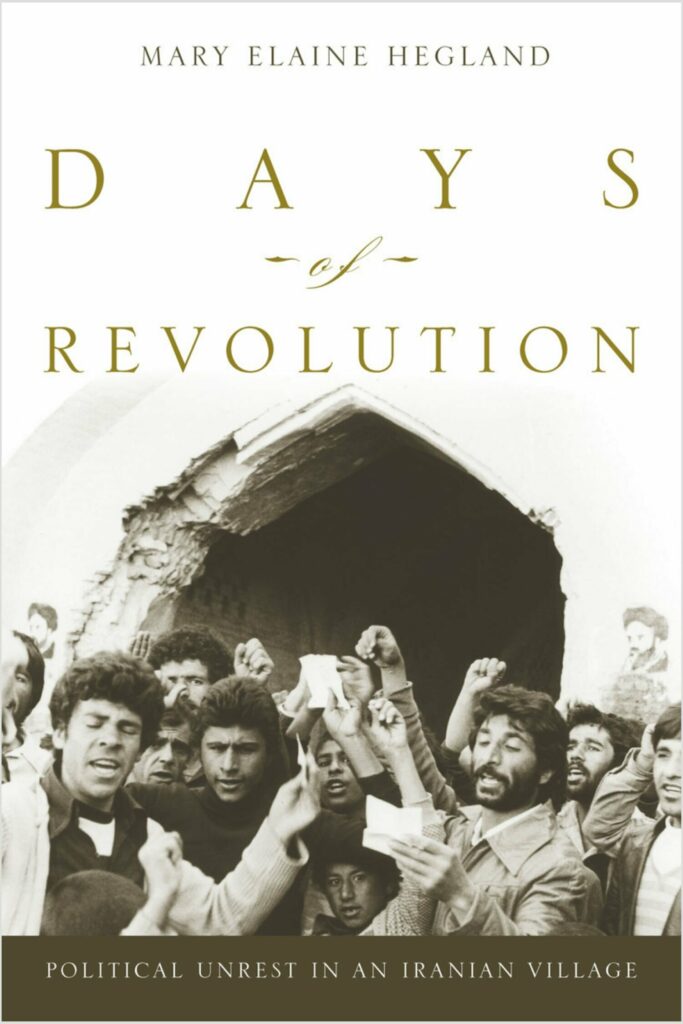
Days of Revolution
Political Unrest in an Iranian Village
Mary Elaine Hegland
Stanford University Press, 2013 · English
An anthropologist’s first-hand account of how villagers near Shiraz were drawn into the 1979 revolution, and of the village’s politics three decades later.
Mary Elaine Hegland arrived in a village near Shiraz in 1978 for doctoral fieldwork and stayed through the revolution; she is described as the only American researcher to have done fieldwork in Iran during it. Using participant observation and informal interviews, mostly with women, she shows how villagers came to join the uprising. Challenging the view of the revolution as a primarily religious uprising, she argues that the Pahlavis’ uneven modernisation, inequality made visible by work in the city, and the absence of political reform drew them in, and that kin-based factions (tayefeh) became units of political action. Because her fieldwork spans thirty-four years, a final chapter describes how Aliabad, its land largely sold off in a property boom, had become an outlying district of Shiraz.
- Subjects
- Revolution, Rural society
- Region
- Iran
- Discipline
- Anthropology
- Period
- 1900–1979, Since 1979
Details
- Publisher
- Stanford University Press
- Published
- October 2013
- Pages
- 352
- Format
- Paperback
- Language
- English
- ISBN
- 978-0-8047-7568-7
Contents
- Cast of Characters
- Chronology of Significant Events
- Introduction
- 1. Historical Aliabad
- 2. Political Repression: The Mosaddeq Era
- 3. Economic Transformation and Political Space
- 4. Recruitment to Revolution
- 5. The Final Months
- 6. After the Revolution: The Local Uprising
- 7. Aliabad: Thirty-Four Years Later