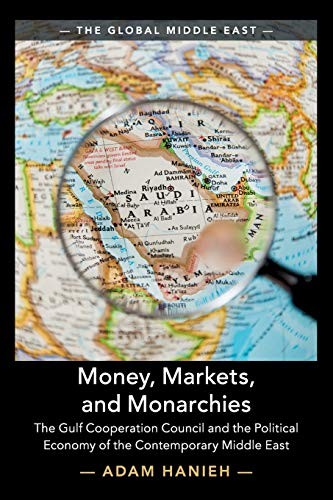
Money, Markets, and Monarchies
The Gulf Cooperation Council and the Political Economy of the Contemporary Middle East
Adam Hanieh
Cambridge University Press, 2018 · English
An analysis of the political economy of the Gulf Cooperation Council states and of how Gulf capital has become a central force in the wider Middle East and the world economy.
Adam Hanieh argues that the Arab Gulf states, led by Saudi Arabia, the United Arab Emirates and Qatar, now shape the Middle East to an unprecedented degree, chiefly through their financial weight. He traces the place of Gulf financial surpluses in the international order and maps the great Gulf business conglomerates and the boundaries between state and capital. Further chapters follow Gulf capital through agribusiness and food chains, the built environment of Arab cities and the financialisation of the region, before turning to how the Gulf Cooperation Council states envision capital under the ‘new normal’. The book received the International Political Economy Group book prize in 2019.
- Subjects
- Political economy
- Discipline
- Political economy
- Period
- Since 1979
Details
- Publisher
- Cambridge University Press
- Published
- 2018
- Series
- The Global Middle East
- Pages
- 314
- Language
- English
- ISBN
- 978-1-108-45315-8
Contents
- 1 - Framing the Gulf: Space, Scale, and the Global
- 2 - Gulf Financial Surpluses and the International Order
- 3 - Boundaries of State and Capital: Mapping the Gulf’s Business Conglomerates
- 4 - From Farm to Shelf: Gulf Agro-Commodity Circuits and the Middle East
- 5 - The Arab Built Environment, Accumulation, and the Gulf
- 6 - Spaces of Financialisation in the Middle East
- 7 - Visions of Capital: The GCC and the ‘New Normal’
- 8 - Future Paths and Political Ends