
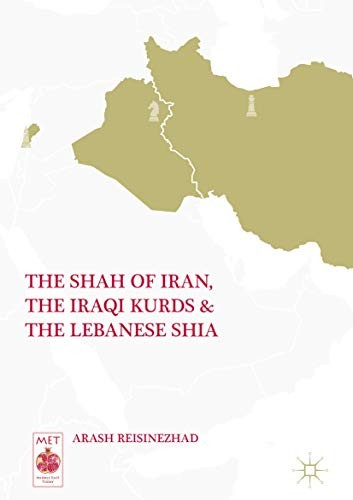
The Shah of Iran, the Iraqi Kurds, and the Lebanese Shia
Arash Reisinezhad
Palgrave Macmillan, 2019 · English
An archival history of how the Shah’s Iran worked with non-state groups, above all the Iraqi Kurds and the Lebanese Shia, to counter its regional rivals between 1958 and 1979.
Arash Reisinezhad studies a little-known side of Pahlavi foreign policy: Iran’s ties with non-state groups beyond its borders. Using archival records from Iran and the United States, he shows how, after the 1958 coup in Iraq brought a pan-Arab, Soviet-friendly republic to Iran’s border, the Shah, SAVAK and the foreign ministry backed Mulla Mustafa Barzani’s Kurdish forces against Baghdad and cultivated the Shia of southern Lebanon as a check on Arab nationalism. The chapters follow this policy from its beginnings through its rise, stalls and collapse to its revival on the eve of the revolution. The book argues that the Shah acted with real autonomy, and that Iran’s later reliance on non-state allies has roots in this period.
- Subjects
- Armed groups, Foreign policy, Security
- Region
- Iran, Middle East
- Discipline
- History, International relations
- Period
- 1900–1979
Details
- Publisher
- Palgrave Macmillan
- Published
- July 2018 (© 2019)
- Series
- Middle East Today
- Pages
- xvi + 357
- Format
- Hardcover
- Language
- English
- ISBN
- 978-3-319-89946-6
- Translation
- Persian: شاه و شطرنج قدرت در خاورمیانه، ترجمهٔ پریسا فرهادی، نشر نی، ۱۴۰۳ (2024)
Contents
- Introduction
- Driving Forces
- Inception: Iran’s Non-State Foreign Policy in pre-1958
- Creation: Iran’s Non-State Foreign Policy in 1958–63
- Ascension: Iran’s Non-State Foreign Policy in 1963–68
- Limbo: Iran’s Non-State Foreign Policy in 1968–73
- Downfall: Iran’s Non-State Foreign Policy in 1973–77
- Resurrection: Iran’s Non-State Foreign Policy in 1977–79
- Conclusion: Iran’s Non-State Foreign Policy and the Shah’s Legacy