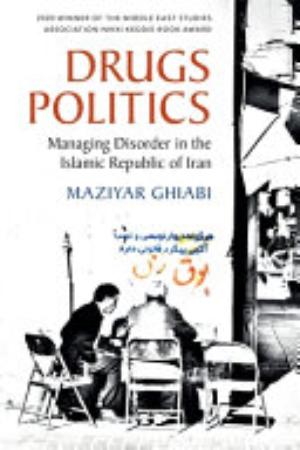
Drugs Politics
Managing Disorder in the Islamic Republic of Iran
Maziyar Ghiabi
Cambridge University Press, 2019 · English
A historical and ethnographic study of drug policy in Iran that uses the state’s handling of drugs and addiction to examine how the Islamic Republic governs crisis.
Maziyar Ghiabi treats drugs as part of the wider relationship between state and society in twentieth- and twenty-first-century Iran. Combining historical research with ethnographic fieldwork, he traces opiates under the Pahlavis, the place of drugs in the revolution and the war with Iraq, the reformist turn to harm reduction, and the role of the Expediency Council in drug legislation. A second part, based on extensive ethnographic observation and interviews with officials and activists, follows the spread of methamphetamines from the 2000s, the new rehabilitation camps, and the populist drug politics of the Ahmadinejad years. Ghiabi argues that addiction is a political construct and that drug policy shows a state that manages disorder through ambiguous, often contradictory measures rather than resolving it.
- Subjects
- Health and medicine, State and governance
- Region
- Iran
- Discipline
- Anthropology, Political science
- Period
- 1900–1979, Since 1979
Details
- Publisher
- Cambridge University Press
- Published
- 2019
- Language
- English
- ISBN
- 978-1-108-46693-6
Contents
- Prologue: ‘Not the King but the Minister … Not the Law but the Police …’
- 1 - The Drug Assemblage
- Part One
- 2 - A Genealogy of Drugs Politics: Opiates under the Pahlavi
- 3 - Drugs, Revolution, War
- 4 - Reformism and Drugs: Formal and Informal Politics of Harm Reduction
- Interregnum
- 5 - Crisis as an Institution: The Expediency Council
- Part Two
- 6 - The Anthropological Mutation of Methamphetamines
- 7 - The Art of Managing Disorder
- 8 - Drugs and Populism: Ahmadinejad and Grassroots Authoritarianism
- Epilogue: Power, Crisis, Drugs