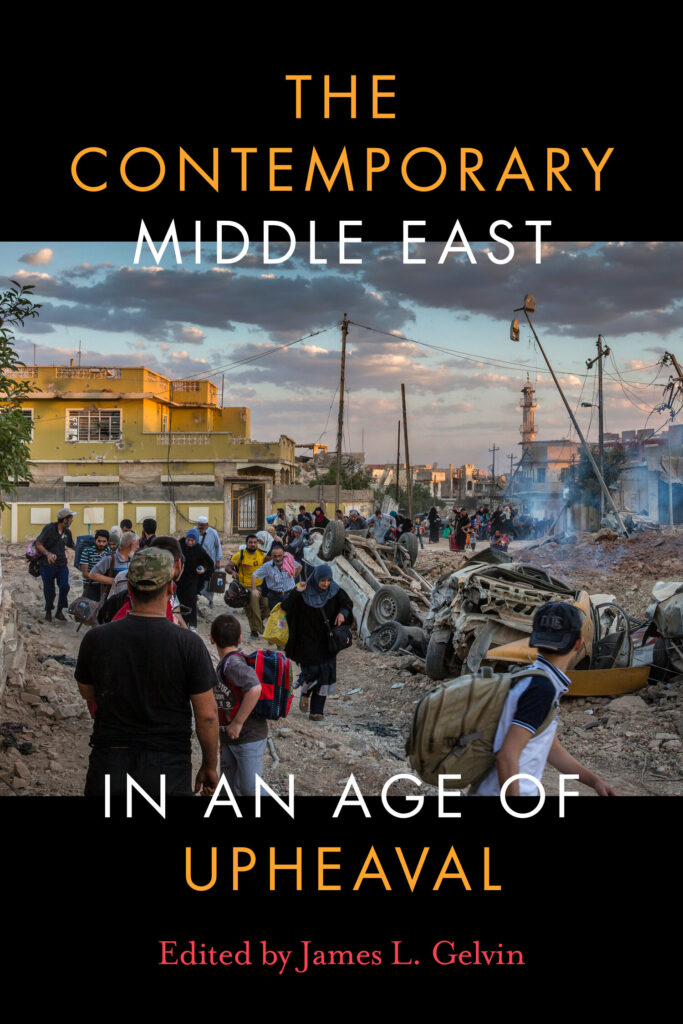
The Contemporary Middle East in an Age of Upheaval
James L. Gelvin (ed.)
Stanford University Press, 2021 · English
An edited volume on the ‘new Middle East’ that has emerged since the occupation of Iraq and the Arab uprisings, covering states, societies and regional politics.
The contributors to this volume, edited by James L. Gelvin, examine the ‘new Middle East’ in four parts: the neoliberal state and what has and has not changed in it; culture and community; long-established states facing new problems; and global and regional dynamics. Chapters connect the Arab uprisings to programmes of economic adjustment, trace changes in political Islam and Islamism, look at Saudi Arabia, Turkey, Syria and Iraq in the context of Wahhabism, occupation, war and refugee movements, and show that proxy wars, once run by the great powers of the Cold War, are now more often started by states of the region. The introduction singles out the occupation of Iraq, the Arab Spring and fast population growth, and describes a new order defined by crises of legitimacy, sectarianism promoted by states, interventions in neighbouring countries, a United States inclined to pull back and a fading Arab–Israeli conflict.
- Subjects
- Social movements, State and governance
- Region
- Middle East
- Discipline
- Political science
- Period
- Since 1979
Details
- Publisher
- Stanford University Press
- Published
- May 2021
- Pages
- 368
- Format
- Hardcover
- Language
- English
- ISBN
- 978-1-5036-1506-9
Contents
- Introduction: A New Middle East? — James L. Gelvin
- Part 1. Continuity and Change in the Neoliberal State of the Middle East
- 1. Is There a New Middle East? What Has Changed, and What Hasn’t? — Joel Beinin
- 2. What Future for the Private Sector in the New Middle East? — Ishac Diwan
- 3. Education and Human Security: Centering the Politics of Human Dignity — Laurie A. Brand
- 4. Myths of Middle-Class Political Behavior in the Islamic Republic — Kevan Harris
- Part 2. Culture and Community in the New Middle East
- 5. Poets of the Revolutions: Authoritarians, Uprisings, and Rappers in North Africa, 1990s–Present — Aomar Boum
- 6. Islamism at a Crossroads? The Diffusion of Political Islam in the Arab World — Peter Mandaville
- 7. Islamists before and after 2011: Assuming, Overlooking, or Overthrowing the Administrative State? — Nathan J. Brown
- 8. Homeland (Dis-)Engagement Processes among the New Syrian Diaspora — Lindsay A. Gifford
- Part 3. Old States, New Dilemmas
- 9. Saudi Arabia: How Much Change? — F. Gregory Gause
- 10. Erdoğan, Turkish Foreign Policy, and the Middle East — Henri J. Barkey
- 11. The Syrian Civil War and the New Middle East — James L. Gelvin
- 12. State Building, Sectarianization, and Neo-Patrimonialism in Iraq — Harith Hasan
- Part 4. Global and Regional Dynamics of the New Middle East
- 13. The Post-Uprising Transformation of International Relations in the Middle East and North Africa — Fred H. Lawson
- 14. Proxy War and the New Structure of Middle East Regional Politics — Marc Lynch
- 15. International Law, Use of Force, and the New Middle East — Aslı Ü. Bâli
- Afterword: The Fourth Dream — Moncef Marzouki