Bridging Iranian Studies and Persian Gulf Studies (©Background)

/Dialogue | Reading Time: 17 minutes
Bridging Iranian Studies and Persian Gulf Studies
A Cenversation between Arang Keshavarzian and Mehran Kamrava
Arang Keshavarzian, Samar Saremi, and Mehran Kamrava | December, 2025
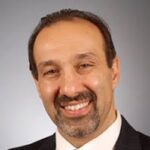
Dr. Mehran Kamrava is Professor of Government at Georgetown University Qatar and director of the Iranian Studies Unit at the Arab Center for Research and Politics Studies in Qatar. Among the dozens of his books and academic publications are a series of important works on Iran and the Persian Gulf region. They include: How Islam Rules Iran? (Cambridge University Press, 2024), Righteous Politics: Power and Resilience in Iran (Cambridge University Press, 2023); Troubled Waters: Insecurity in the Persian Gulf (Cornell University Press, 2018); Qatar: Small State, Big Politics (Cornell University Press, 2015); and edited volumes such as Gateways to the World: Port Cities in the Persian Gulf (Oxford University Prewss, 2016); The Political Economy of the Persian Gulf (Oxford University Press, 2012).
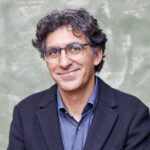 Dr. Arang Keshavarzian is Professor of Middle Eastern and Islamic Studies at New York University. He is the author of Bazaar and State in Iran: Politics of the Tehran Marketplace (Cambridge University Press, 2007 and translated into Persian by Shirazeh Press) and Making Space for the Gulf: Histories of Regionalism and the Middle East (Stanford University Press, 2024). He is the editor of Global 1979: Geographies and Histories of the Iranian Revolution (Cambridge University Press, 2021).
Samar Saremi is an architect who graduated from McGill University and is now a PhD candidate in anthropology at the Université de Montréal. She is currently a partner at Tajeer Consulting Architects in Tehran, Iran. Her doctoral thesis, titled “Healing in Mashhad: Imam Reza Shrine pathologized in Iran (1883 to 1941),” focuses on the role of sanitary concerns in shaping the modern city of Mashhad.
Arang Keshavarzian (A.K.): You are one of the few scholars and researchers who have both an active research profile in Iranian studies and in what we usually described as “Gulf Studies.” You have worked on and published on various issues related to Iranian politics, history, and society. But at the same time you have also been actively thinking about and doing research on the Arabian Peninsula and what we widely call the Persian Gulf region.
Your works examine international relations and connected histories and societies that span the Persian Gulf. And you’ve been doing so for a number of years. Roughly out of your 30 books and edited volumes, 10 are works related to the Persian Gulf region. So maybe we should start by asking you to reflect a little bit on Gulf studies and how you became engaged with it, both personally and professionally. In fact, do you even think of yourself as a scholar of the Gulf?
Mehran Kamrava (M.K.): Thanks again for the opportunity. I’m honored, and it’s really a huge honor to be part of this exciting project. So, you know, I, really considered myself a Middle East generalist. I wrote my dissertation on Iran, published a couple of books on Iran back in 1990-92. And then, I didn’t want to have anything to do with Iran. I was already tired of it. I went to study other stuff. And then, one thing led to another, and I wrote about Iran again in 2008. But by then my family and I had moved here in 2007; that is to Doha. And, although we thought that we would leave soon and go back, we ended up staying long-term. And almost immediately, I discovered a couple of things as a student of the Middle East.
First thing I discovered was that Iran and the countries on this side of the Persian Gulf have an awful lot in common. But there is literally a gulf in understanding between these sides. And despite the fact that there are political and historical dynamics and cultural commonalities, there’s really miscommunication at multiple levels, not just nationally and politically, but more importantly, intellectually. And there was this intellectual gulf that separated the two. So that was one kind of glaring thing that really struck me when I first came here.
The other thing that I simultaneously discovered back when I first moved here was that, in many ways, the study of Gulf politics and Gulf Studies had fallen by the wayside, and that as students of the Middle East had been focusing too much on places like Egypt, Iran, Iraq, and the Levant. And this was really to the detriment of an area that was becoming in many ways the new heart of the Middle East, where diplomacy was taking place, where there was innovation, where there were interesting things happening. But there was hardly any research [on the Gulf region] that was current. There had been some research in the 1970s, an article or a book had appeared in the 1980s, here or there. But by the 2000s, in many ways, this area had become intellectually neglected and the Gulf was a blank canvas, and you could really pick up any topic and study it, and discover that you had something original to say.
So, these two developments prompted me really to shift my focus from kind of the broader study of the Middle East, and become much more specific looking at, first, the commonalities and kind of the common denominators between Iran and countries in the Arabian Peninsula on the one hand, and then looking at political dynamics here in the Arabian Peninsula. I was fortunate that here at Georgetown University, we were able to do a series of studies and we were also fortunate to have you as part of some of those. So, you know, we looked at international relations of the Persian Gulf states, we looked at political economies of the Persian Gulf and issues of migrant workers, and issues of Gulf cities. And in all of these, I was conscious to include not just the Gulf states, per se, but also Iran, because I saw the Persian Gulf as an organic whole that had somehow been put into different silos by scholars, not because of lack of interconnections, but because of our own misperceptions and kind of our own approaches that saw things in different silos without a broader understanding of this region. I did a series of studies that viewed Iran as embedded in these kinds of dynamics, and you, Arang, were involved in our study of Gulf cities. I deliberately talked about Abadan and other Iranian cities. We had someone from University of Tehran talk about Bandar Abbas. Of course, we had scholars, like Ahmad Kanna, who were looking at Dubai and elsewhere in the Arabian Peninsula. So, again, we were looking at this kind of organic whole, and as I mentioned, we did this in in terms of economics or political economy, international relations, and migration back and forth. We did this when we studied migrant workers and included Iranians in this topic. It’s not just people from Kerala who have historically migrated to this region, but also Iranians from southern, provinces, also from Sistan-Baluchestan, and the rest of Iran.
And then you asked me a question which I really haven’t thought about, which is, how do I classify myself. Do I see myself as a Gulf Studies person or in Iranian studies? I don’t know, I still think that I look at the Middle East as an organic whole, and I maintain that our traditional assumptions about the core of the Middle East have had to change because now it’s no longer Cairo, Baghdad, and Damascus that shape the destinies of the rest of the Middle East, but it’s places like Abu Dhabi, Dubai, and Doha. Their influence is for different reasons, and in different forms, but these are the new epicenters, or the new hearts of the Middle East. I’m still involved in the study of Iran actively, but also actively involved in the study of this region of the Arabian Peninsula. And again, I continue to see there are a number of very profoundly important common denominators, despite different historical dynamics, that bind this side of the Gulf to that side of the Gulf together.
A.K: Thank you, that’s really helpful. In a sense, your career coincided with this regional geopolitical shift you describe. And you were able to witness the rise of Qatar and UAE and these places first hand.
Let me just pick up one of the themes that you just mentioned. As someone who has studied these issues from the angle of the United States, one of my frustrations has been is that when people talk about “the Gulf,” they are almost always only speaking about the Gulf Cooperation Council. And Iran, Iraq, and Yemen are not included in those discussions. And what’s nice about the projects that you’ve been involved with and spearheaded, is that you always force us to bring in not only Iran, but Pakistan and Iraq into the fold. And you force us to ask how meaningful it is to reduce the Gulf to these six, relatively small states. What about thinking about the long histories of connectivity and exchange and so forth?
But here let me ask you to put your Iranian studies hats on and reflect a little bit about how your deep research on the Arabian Peninsula has reshaped the sorts of questions you ask about Iranian politics and Iranian history. Are there questions that you didn’t consider before your engagement with the Arabian Peninsula society? What can Iranianists learn by thinking about Iran in relations to the Persian Gulf region?
M.K.: Yes, you know, that’s a really good question, and it’s something with which I actively grapple. And, this is what I discovered. When I came here, I suspect, not unlike many other Iranians, I always thought that if only my Arab colleagues understood Iran. The problem is that people do not know Iran. And then, slowly, it occurred to me that the fear of Iran that exists in the Arab countries of the Gulf cannot be dismissed. It’s not a product of ignorance. And that Iranian foreign policy, and in many ways the Iranian politics as a whole, can be every bit as sectarian as Bahraini, Saudi, and Kuwaiti, and other politics. I hadn’t realized this; maybe because I am a product of it or I was so immersed in it or immune to it or inured to it, I hadn’t realized how deeply ideological and sectarian Iran is.
And that the fear of Iran actually comes through when you listen to some of these statements coming out of Tehran. You have your Arab colleagues remind you of it. And there is the fact that, for example, in a small city like Doha, there are 4 or 6 Shia mosques, but in a big city like Tehran, there’s not a single Sunni mosque. Then you realize that, wow, it’s not just this side of the Gulf where there’s sectarianism that influences the rhythm of political life, but that side is just every bit as sectarian. it’s just that I wasn’t aware of it, for whatever reason, I had my own myopia, my own training, my own focus on something else. For me, this was a real awakening, actually, I have to say.
A.K.: So being in the Arabian Peninsula, being in Doha, has forced you to grapple with the diversity in Iran that, in a sense, is silenced by the way we tell its history, and think of Iran’s society, or view its urban landscape.
M.K.: Yes, absolutely. Exactly. And as you know, in addition to being a professor at Georgetown, I direct the Iranian Studies Unit at the Arab Center for Research and Policy Studies, and in 2024, our annual conference was on the topic of study of the social sciences in Iran. And one of the studies that we sponsored and supported was the study of Sunni areas in Iran, Sunni majority areas by Iranian scholars and social scientists, and probably I would have not realized the academic value and depth of such a study had I not been exposed to the other side.
A.K.: If I could follow up on that theme, one of the characteristics of your work has been your very collaborative spirit and your attempt in various ways to bring researchers from Iran, from North America, and from the Arab world together in the same room, or in the same edited volume, or in a single conference. And hopefully our readers will look up these projects and become more familiar with them, but I’m wondering if you could point to a couple examples and share with us some of the motivations or your hopes when you organized them.
M.K.: Yes, one of the joys of being in Qatar is that we can do things here as a convening forum that we couldn’t have done anywhere else. I say that without exaggeration. There are very few places, particularly under current political circumstances, where you can have Iranians, Americans, Saudi Arabians, Emiratis and various Europeans, around the table at the same time. And it’s been an absolute pleasure. When I first came here as the director of our research center at Georgetown, the Center for International and Regional Studies, one of the questions I asked myself is how do I use our location as a source of comparative advantage? And how do we use this as a place of intellectual production that we couldn’t have done elsewhere. We couldn’t have done it in London or Washington, or elsewhere. And it was kind of a realization. There are the resources here, there’s the opportunity, and then there is the convening power and the logistical transportation abilities to bring everybody here. And so I did that with the Center for International and Regional Studies, and since 2020 at the Arab Center for Research and Policy Studies I’ve been able to do that with this Iranian Studies unit.
At this unit, given sanctions and the difficulties that many of our colleagues in Iran have, I’ve tried to provide a forum for publication, for presentation, and for dissemination of research, as well as for dialogue and exchange of ideas and for building a network with colleagues from the U.S, colleagues from Europe, and elsewhere. And it’s been both intellectually rewarding, but also it’s been rewarding at a personal level as well.
A.K.: And I suspect in the last 4 or 5 years, things have become slightly easier due to the tensions between Iran and Saudi Arabia, for instance, easing. I imagine there more interest to build these sorts of bridges.
M.K.: Right. One of the things I’m most proud of is when we had an online discussion with someone from Riyadh and someone from Tehran. We had a professor from University of Tehran, Professor Ariabarzan, Mohammad Mahdi, and then someone from Saudi Arabia. And that, to me, was really fantastic to be able to facilitate that and break those other barriers that don’t need to exist to intellectual and academic exchanges.
A.K.: If I can put you on the spot, and you don’t have to mention names, I suspect that in these past couple decades there have been moments when things have been lost in translation, or there are awkward moments when you’re convening people from different backgrounds and different intellectual cultures. Can you think back to moments where this attempt to build bridges and bring these people who don’t usually talk to each other together hasn’t worked out and there were tensions, miscommunication, and misunderstanding.
M.K.: I can give you two concrete examples, one of which happened just recently, when we had our annual conference on Iran and the new strategic environment, Iranian foreign and security policies in a changing strategic environment in the Middle East, and we had scholars from Yemen, based in Yemen. We had, of course, scholars from different Iranian universities, and we had scholars from Jordan and Iraq, Iraqi Kurdistan, and we had scholars from Qatar. And one of the things that happened was some scholars were less analytical and more accusatory in their discussions. In my closing remarks, I pointed out that the idea of Iranian Studies Unit isn’t necessarily to provide an arena to accuse this or that, but to look at cause, process, consequence, and foster intellectual dialogue and exchange of ideas, rather than simply to provide a forum for airing out grievances against the other side. And as you know, in these kinds of forums, everyone is on their best behavior, but at the same time, either through allegory or sometimes more directly, they do kind of make accusations—”Iran this,” or, I don’t know, “Arabs that,” or, America did this and did that.” Meanwhile the goal is to get beyond these kinds of accusations and look at more analytical stuff. So that’s one example. Yeah, it happens, but you’ll have to get pass them.
The other one is, early on. we were encouraged by Georgetown University, which sees itself as kind of proactively involved in diplomacy to become a forum for Track 2 dialogues[1]. And so I would bring Iranians, Saudis and Americans to foster Track 2 discussions. And quickly, I discovered that, at least the way we were doing it was not necessarily being productive, because either you bring in a lot of people who read from the same page and say the same thing as one another, but are devoid of a broader political or social context. And their exchanges don’t necessarily have broader traction. Or you bring in people that state their position and they come just to have stated their position and they go back and they’re entrenched [in their outlook]. And so, I have to say that I most likely wasn’t doing it right; my experience with using our forum for Track 2 purposes didn’t necessarily work, or at least it wasn’t nearly as successful as I had originally hoped it would be.
A.K.: Let me turn our attention to the future. Let me underline that I agree with you that scholarship on the Gulf in the 1990s and even early 2000s was very limited. There were very few works and almost all on geopolitics and rentier state theory. It’s very different now. We have much more and more varied research. But looking ahead, and there’s a lot of young scholars and researchers in different fields, history, urban studies, anthropology, and so forth, working on the Persian Gulf. What do you see as important topics and questions that we should be studying in the near future. Or if you were speaking to PhD students in Iran or the Arab world what sorts of projects do you think we need in the coming years.
M.K.: Thank you for that question, because sometimes I want to turn to Iranian PhD students and say, look, enough of realism. We know “defensive realism,” [a concept in international relations theory.] Just stop writing yet another PhD dissertation on defensive realism.
I teach a course called Politics and Society in the Gulf, and it has made me think about emerging topics of research. Broadly, there are three highly consequential developments underway here in the Persian Gulf region that demand greater scholarly and academic attention. First and foremost are issues related to what are generally called “critical security” developments—those related to identity, citizenship, nationality, and climate, for example. Questions around citizenship and nationality, which were once important in the 1960s and the 1970s, around the time when most Persian Gulf states became independent, are once again reemerging as highly consequential developments in people’s daily lives and therefore demand scholarly attention. Similarly important are questions related to the environment. There are, of course, a number of critical issues related to climate change and its impact on both the desert and the Persian Gulf ecosystems. But equally important are the ways in which regional states manipulate environmental issues for purposes of political legitimacy, claim to champion environmental protection while at the same time continue to build airconditioned outdoor spaces for the comfort of their populations.
A second emerging area that demands greater scholarly attention are the ongoing changes to the prevailing “ruling bargains” on which regional states rely to govern. My sense is that the current robust entitlement system that states have in place for their citizens is at some point bound to change. How states navigate this transition, the way that they have been able to govern, the bargain that they have struck, the social contract on which they’ve relied, has to change. And that will be a change to the social contract. I think this is really important, not just for resource-poor countries, such as Oman and Bahrain, but for places even like the UAE, Qatar, and Kuwait. A redrawing of existing ruling bargains, which are basically premised on the political compliance of the population in return for extensive social and economic benefits from the state, is inevitable as states try to lessen their dependence on revenues from oil and gas. Already we see the imposition of value added tax, which previously did not exist, in places such as Saudi Arabia and the UAE. Kuwait has even gone as far as to resort mass citizen revocation, because citizenship is extremely expensive, and the state is trying to reduce its number of citizens.
Third and related to this is the use of new methods for authoritarian control, chief among which is use of social media. There has already been some attention to what Marc Owen Jones, a professor at Northwestern University in Qatar, has called “digital authoritarianism.” Given the importance of maintaining a tight political grip by state elites across the region, both control over and the manipulation of cyberspace for political purposes is something to which Persian Gulf governments pay sustained attention. This dimension of rule, and its manifold political and cultural consequences, should not escape our attention.
A.K.: What’s interesting to me is that all three topics you laid out are deeply relevant for Iran. They can be thought of comparatively and not just an Arabian Peninsula issue or just an Iranian question. Obviously, there are different histories and different social and economic dynamics, but the large number of Afghans in Iran also face a similar plight when it comes to questions of citizenship and deportation as non-Citizens in Arab Gulf states.
M.K.: Absolutely, it’s not just loss of citizenship, but it’s access to state resources, like schooling, which, as you know, for Afghans in Iran, is a major issue. And so, absolutely, it’s not just expulsion and revocation. In fact, we were just talking in my class, it’s related to the question of having travel documents. Do you have papers? Can you pay for your utilities? Do you have access to running water? It’s all those things that, on a day-to-day basis, people really have to grapple with.
A.K.: As you may know, some universities in Iran, specifically, Bushehr University and Hormozgan University, have departments and programs in Persian Gulf Studies. I was curious to know if you tried or have had any collaborations with any universities or institutes in Iran on the Persian Gulf.
M.K.: Unfortunately, not. that’s a shortcoming on my part, or on our part. We have collaborated extensively with University of Esfahan, University of Mazandaran, University of Tehran, Tarbiat Modarres University, Alame-Tabatabai University. And I personally collaborate extensively with a colleague at Yasuj University. I’m kind of determined to go outside of Tehran. But unfortunately, we haven’t been able to work with those universities. We have reached out, but probably not enough to Persian Gulf Studies centers at the Hormozgan or Bushehr University.
Samar Saremi: Recently, I visited Bushehr, where a research center is located directly facing the Persian Gulf in a charming old building with a courtyard. Although their primary focus is on the histories of Bushehr and the surrounding region, they refer to the institute as the “Iranian Studies Foundation” rather than “Persian Gulf Studies” or any other regional classification. Over the past ten years, we have observed a shift in architectural and urban projects towards the southern region of Iran, driven by increased funding for various types of development. This area has also gained more international recognition, notably receiving a prestigious award from the Aga Khan Development Network (AKDN) for the Majara Complex and Community Redevelopment project on Hormoz Island. While we celebrate the recognition of southern Iran and the development of its sites, we also strive to understand what lies beneath the surface of this enthusiasm. Do you share this observation? We would appreciate your insights as experts on this matter.
M.K.: You know, to a lesser extent. I haven’t been able to engage actively with centers in Busheher and elsewhere on the Persian Gulf.
But one of things that has been really a joy for me is that when we get submissions, it’s not just from the University of Tehran or from other Tehran-based universities. It’s also from University of Gilan, and University of Mazandaran, and University of Yasuj, and from one of the branches of Azad University in cities such as Kermanshah or Sabzevar.
One of the difficulties that I have is explaining to my colleagues outside of Iran, particularly those in the US, that there is a robust and vibrant intellectual culture in Iran. One of the things people outside of Iran don’t realize is that an incredible intellectual culture exists in Iran and the feature vibrant and in-depth debates. And many of the issues that are discussed and studied in Iran are often much ahead of what we talk about outside of the country. In many respects, given Iranian academics’ greater familiarity with and involvement in the context of what is happening inside the counties, their discussions are much deeper. My hope is to tap into that insight and to engage more deeply with Iranian academics, in the process going beyond universities in Tehran and reaching out to academic across the country.
A.K.: Let me briefly add that it does seem to me there is a far more attention being paid to coastal cities in recent years and there are projects, investments, and tourism. But we should be careful to evaluate its consequences. Also from afar I have sensed a growing interest in southern Iran for people to record local histories and documenting everything form the architecture to music to shipbuilding. I follow some of these developments on Instagram pages where people interview old sailors and photograph buildings. I’m sure it’s been there in the past, but partly because of social media, people are very consciously trying to capture these things and interviewing older members of their community. This includes more openly talking about questions of Iranians of African background, race, and racism. It seems to me that these people are trying to tell their own histories, rather than letting just Tehran tell the story. They are looking at Iran from the perspective of Bandar Abbas and Lengeh. And I think some of that is happening also on the Arab side of the Gulf with families collecting and sharing their own documents about merchant families. People are using these new technologies to try to tell family and personal histories, rather than national or state histories.
Footnotes
- Track 2 refers to non-governmental forms of dialogue, trust-building, and diplomacy. It is argued that it can facilitate and help initiate formal diplomacy. In the 2000s there were various Track 2 initiatives to help diplomacy between Iran and western states. ↑
Related Content
 GlobIS Review, Volume 2, Issue 2 (©Background)
  New Horizons in Persian Gulf Studies (©Background)
  The Identity Politics of a Body of Water: On Persian Gulf Studies in Iran (©Background)
  Migration and Citizenship in Eastern Arabia: A Review of the Field
  A Review of the Persian Gulf Studies Quarterly (©Background)
  Short Reviews*
Comments are closed.