Editorial
In recent years heat waves, droughts, sandstorms, toxic pollution, and more have made the lives of people living in and around the Persian Gulf challenging. Ongoing political crises and rising poverty in Iran and Iraq, the populous northern shore of the Gulf has given rise to extreme social inequalities that add fuel to the region’s already volatile geopolitical divisions. For many these crises have not led to a sense of a shared present or future as the prevailing notions of national exceptionalism and state responsibility have restricted perceptions of politics within the orbit of the national scales rather than the wider Persian Gulf regional. Even as Israeli missile and drone attacks targeted Iran, Qatar, and Yemen, it was forgotten by most that it was GCC states that had helped organized diplomatic channels between the US and Iran that were scuttled by the 12-day war, or that many Iranians turned to Bushsher and Bandar Abbas to secure safe passage across the Gulf…
- Azam Khatam
In this conversation, Azam Khatam speaks with Kaveh Ehsani (Associate professor of international studies, DePaul University) and Arang Keshavarzian (Proferssor of Middle Eastern and Islamic Studies, New York University New York University), both contributing editors to this special issue, about the trajectory of Persian Gulf Studies. Reviewing the longer history of the Persian Gulf, as well as engaging with trends in the fields of Gulf studies, they outline a new wave of scholarship that situates the Gulf within the history of capitalism and not bound by modern national borders. This emerging scholarship moves beyond single-factor explanations—imperialism, modernization, nationalism, and oil-centrism—and critically questions static binaries and narrow analytical frameworks such as geopolitics, traditional/modern, sectarian divisions, Iran–Arab rivalries conflict, and the rentier petrostate. Instead, this new scholarship focuses on making space for the analysis of the agency of diverse social actors. They also discuss how such critical scholarship has been able to flourish during moments of expanding democracy and academic freedom in the region…
- Arang Keshavarzian
This interview explores the evolving landscape of Gulf Studies, highlighting the work of a scholar whose research bridges both Iranian Studies and Persian Gulf Studies. This interview with Mehran Kamrava examines his initiatives to open dialogue between social science scholars inside Iran and those abroad, reflecting on how cross-border engagement can enrich both local scholarship and the broader field of Iranian Studies globally. Arang Keshavarzian and Samar Saremi conducted this interview with Mehran Kamrava on October 7, 2025.
- Mahbubeh MirzaeiCrude Oil and the Mirage of Development, by Roya Khoshnevis
Crude Oil and the Mirage of Development draws on Roya Khoshnevis’s doctoral dissertation, defended in 2021 at the University of Amsterdam, to explore the lived experience of oil as reflected in modern Iranian literature. It provides a fresh analysis of modern Iranian literature through the lens of Human Energy Studies, which explores how energy systems impact economic and political relations as well as collective consciousness, culture, and art and literature creative works…
- Ehssan SiapoushMaking Space for the Gulf, by Arang Keshavarzian
The Persian Gulf has always been simpler to conquer than to define; empires found taking possession far easier than explaining precisely what it was they had possessed. No shortage of maps, treaties, and monographs have declared it a region—as if coherence were native to the water rather than imposed upon it. Geography here is logistics in disguise: space defined less by cultural affinity than customs regimes, maritime chokepoints, and extractive discipline. Arang Keshavarzian’s Making Space for the Gulf does away with this comfortable illusion. Rather than define the Gulf, it dismantles the very notion that there was ever something coherent to define…
- Sanaz SohrabiDocumentaries, by Ebrahim Golestan
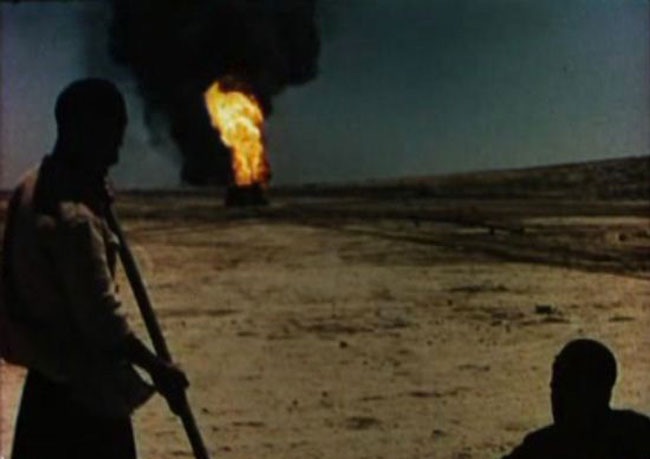
There has been a renewed interest in revisiting Ebrahim Golestan’s early documentary films about oil. This is in part due to the current focus on the historical ties between extractive industries and their contribution to the global media culture in the 20th century. The turn toward the energy corporations’ expansive array of cinematic and photographic production and their remaining archives has played a crucial role in rethinking the relationship between cinema and oil, and how each constituted the dreamworlds of modernity by their distinct magic. While the film oeuvre of Ebrahim Golestan has always held a special place in the Iranian cinema, examining the link between the political economy of oil and the cultural infrastructures of oil in shaping the careers of pioneering figures within the Iranian New Wave cinema, with Golestan as a canonical example, is a recent focus. Ebrahim Golestan is an eccentric figure in the history of Iranian cinema, his personality and celebrity status often created an aura through which his films were interpreted and perceived. In a reverse act, I propose to consider oil as an analytical optic through which we can reframe a new portrait of Golestan, not simply as a filmmaker with several commissioned films about oil, but as a figure who was symptomatic of Iran’s encounter with modernity. From this perspective, oil can help us see Golestan differently and understand how modernity was translated and reflected upon within the cinematic registers of the Iranian New Wave movement.
- Hamidreza Yousefi, by Enjavi Shirazi, Khosrow Khosravi, Jalal Al-e Ahmad, Karim Keshavarz
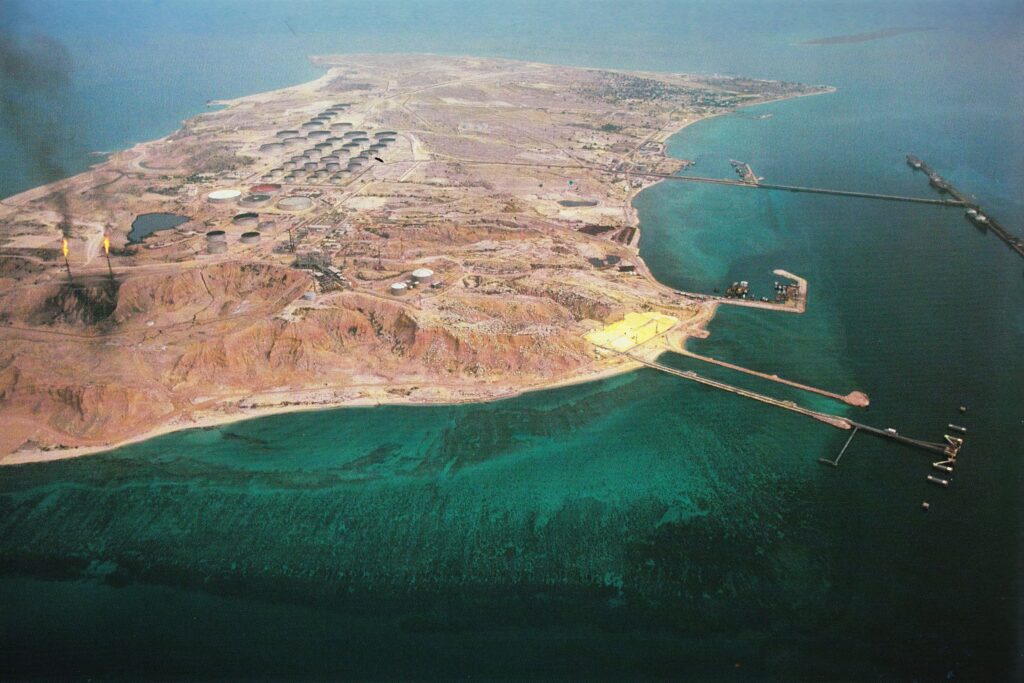
If we set aside the long and tumultuous history that Kharg has endured, the island acquired a distinct status during the reign of the second Pahlavi—both because of the political authority asserted by the state and because of the dominance of oil, the “black gold” of the modern age. On one side, Kharg became a place of exile for political opponents of the regime, particularly between 1946 and 1958, serving primarily as a site of banishment for leftists and members of the Tudeh Party. On the other side, with the discovery and expansion of oil operations, Kharg was transformed into the Pahlavi state’s “treasure island,” capable of financing Mohammad Reza Shah’s dreams of building a “modern” Iran.
- Kaveh BayatMilitary Geography of Iran, by Haj Ali Razmara
The seventeen-volume collection Military Geography of Iran, published in Tehran between 1941 and 1946 and supervised by Brigadier General Haj Ali Razmara, is one of the most significant geographical sources on contemporary Iran, with The Iranian Islands in the Persian Gulf (1944) as its principal volume on the Persian Gulf. The order of publication and its underlying logic for separating the volumes are not clear to us, as Iran was then divided into six provinces according to the country division law of 1937. However, the military regions underwent significant changes, growing from nine divisions and four independent brigades stationed across the country in 1935 to 18 divisions by 1940 (Qaem Maghami, p. 78). This total may seem to correspond with the seventeen divisions in Razmara’s Military Geography; however, the classification is not entirely consistent, since two of the eighteen divisions were based in Tehran and four in Azerbaijan, meaning the military territorial divisions were fewer than administrative divisions of the 1937 law.
It is noteworthy that Tehran is not specifically referenced in the Military Geography. Azerbaijan is divided into eastern and western parts, while a separate volume focuses on the deserts of Iran, which do not align with the geographic or military divisions of the country. (ibid.) The primary aim of compiling this collection, especially volumes on the border provinces, was to assess their defense capabilities—highlighting strengths and weaknesses while accounting for geography, communication lines, and other relevant factors. As we will see, the islands are particularly significant in this context. - Shima Vezvaei
The establishment of the field of “Persian Gulf Studies” and the creation of universities and research institutes bearing this title in Tehran or in Iran’s southern coastal provinces dates back to the first half of the 1990s. During the period known as Reconstruction era, the state sought to place the region’s resources more fully at the service of national economic growth through the development of marine sciences and investments in technologies of oil industryIt is noteworthy that Tehran is not specifically referenced in the Military Geography. Azerbaijan is divided into eastern and western parts, while a separate volume focuses on the deserts of Iran, which do not align with the geographic or military divisions of the country. (ibid.) The primary aim of compiling this collection, especially volumes on the border provinces, was to assess their defense capabilities—highlighting strengths and weaknesses while accounting for geography, communication lines, and other relevant factors. As we will see, the islands are particularly significant in this context.
- Alex BoodrookasMigration and Citizenship in Eastern Arabia: A Review of the Field, by Alex Boodrookas
In recent decades, the study of migration in eastern Arabia and the Persian Gulf has become one of the most dynamic subfields of Gulf Studies. This essay introduces its major debates and themes by focusing on three foundational works that opened the door for a new generation of critical scholarship: Andrew Gardner’s City of Strangers (2010), Neha Vora’s Impossible Citizens (2013), and Nelida Fuccaro’s Histories of City and State in the Persian Gulf (2009).