
Making Space for the Gulf (©Background)
ISSN 2818-9434
“Beyond Abadan lieth no further village.”
—Manuchehri Damghani (fl. ca. 1030 CE)
 The Persian Gulf has always been simpler to conquer than to define; empires found taking possession far easier than explaining precisely what it was they had possessed. No shortage of maps, treaties, and monographs have declared it a region—as if coherence were native to the water rather than imposed upon it. Geography here is logistics in disguise: space defined less by cultural affinity than customs regimes, maritime chokepoints, and extractive discipline. Arang Keshavarzian’s Making Space for the Gulf does away with this comfortable illusion. Rather than define the Gulf, it dismantles the very notion that there was ever something coherent to define.
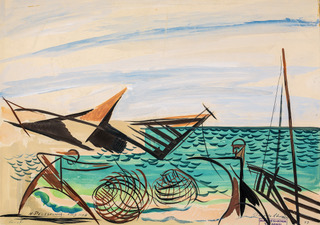
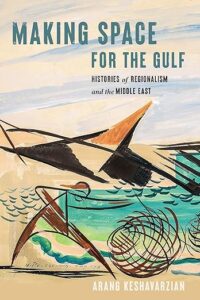
There are familiar tropes in Gulf scholarship: oil as ontology, state as default, empire as prehistory. Keshavarzian refuses to let any one of them set the plot; instead, he folds empire, oil, and the state into a longer genealogy of spatial control. Fittingly, the cover—Houshang Pezeshknia’s painting Fishing in Khark (1958), fragmented in geometry and restless in brushwork—anticipates Keshavarzian’s argument: that the Persian Gulf’s apparent clarity is a carefully staged illusion masking deeper structural conflicts. Keshavarzian’s Gulf, likewise, is a manufactured coherence projected onto a restless landscape. He remains less interested in regionalism as culture or identity than in its spatial mechanics: how space has been assembled, segmented, and operationalized—through treaties, zones, and ports that scholarship is only now beginning to foreground.
The first chapter clarifies the stakes. Regionalism emerges here not as identity or tradition but as a structure produced by circulation—of people, commodities, debts, discipline. Keshavarzian does not recover a pre-state Gulf but demonstrates how mobility, far from disrupting order, enables order. Here, he vindicates Henri Lefebvre’s claim that space itself is a mode of production.
Each chapter isolates a spatial technology, and though the sequence moves broadly forward, it bends chronology to fit the analytic frame: from nineteenth-century regional webs, through imperial enclosure and League-of-Nations diplomacy in Geneva that recast self-determination as cartography, to the 1970s free-trade-zone boom and, finally, the post-oil choreography of Gulf urbanism. Together, these chapters form a topography of statecraft by other means—an anatomy of how space is wielded not to reflect order but to impose it. Readers will find no nostalgic seafaring, no untainted cosmopolitanism. Instead, Keshavarzian delivers an unsentimental history of exclusion—corridors without citizens, cities without publics, regions erased from memory.
Given the severity of these historical insights, Keshavarzian’s analytic restraint is especially noteworthy—but it carries costs. The tone remains detached, cumulative—even when recounting pearl divers shackled by debt or enslaved deckhands sold in Gulf ports. One finishes Making Space for the Gulf suspecting that ‘the region’ itself was just another convenient fiction—like all profitable illusions, effective precisely because its logic remains rarely scrutinized.
The second chapter offers one of the book’s most compelling demonstrations—not narrating the Gulf’s past but interrogating the spatial procedures that made it administrable. Drawing on British imperial archives—not for color, but for form—Keshavarzian reconstructs how ambiguous shorelines and mobile populations, once navigated by pearl divers, smugglers, and tribal negotiators, were recoded into governable units. Treaties, surveys, offshore boundary claims: these were not responses to instability but tools for simplifying space into assets, and in the process seeded new disputes. Geographers may prefer neat lines, but empires always favor theirs dotted.
The argument is meticulous, perhaps excessively so. Keshavarzian’s principled refusal of melodrama, while intellectually admirable, obscures a crucial point: empire itself is melodrama, a spectacle whose violence resists abstraction. Amid the clinical calculus of treaties and zoning laws, one sees, beneath the neat jurisdictions, the pearlers drowned by debt, the stranded tanker crews. Yet Keshavarzian remains fixed on spatial techniques: ambiguous shorelines converted into governable units, mobility reframed as containment-worthy threat. His Gulf, once a fluid braid of tribes and trade, reappears as a grid of enforceable jurisdictions. If none of this quite shocks, the execution is nonetheless flawless, strikingly legible even at its most familiar. The danger, Keshavarzian quietly warns, is that scholarly abstraction too readily becomes academia’s tranquilizer, numbing precisely the brutality it seeks to reveal.
The book’s most powerful insight (developed most fully in Chapter 4, “Globalization’s Seams”)—that the Gulf is not geography but infrastructure—recalls Fahad Bishara’s merchants, whose ledgers crafted an economic geography across the Indian Ocean. Yet where Bishara’s narrative teemed with individual merchants and sailors, Keshavarzian leaves us with the cool circuitry of logistics: depopulated, streamlined, relentless. For him, space is neither geographic constant nor metaphor but operations: enclosure, partition, erasure. The Gulf is not merely the empire’s object—it is its artifact. Postcolonial sovereignty still relies on treaties and maritime claims, but its stewards have multiplied. Non-state actors—developers, planners, financiers—now maintain the choreography with a bureaucratic grace the empire never achieved. They do not supplant empire; they extend it. Empire in the Gulf, indeed, never fully retired—it simply re-branded itself as ‘economic partnerships,’ ‘special economic zones.’ The scaffolding remains—redrawn, relabeled, yet functionally unchanged, as the Iran–UAE median-line dispute makes plain.
At times, Chapter Four holds back. One senses that the juridical afterlife of these spatial logics—their reappearance in contemporary zoning regimes, labor exclusions, and offshore finance—is only briefly acknowledged, left for the reader to pursue. The book’s structure suggests deliberate intent: each chapter isolates a spatial mechanism—mapping and concessionary surveying in Chapter Two, treaty regimes and protectorates in Chapter Three, free-trade zones and urban zoning in Chapter Four—sharpens its conceptual edge, then tactfully withdraws. Drawing meticulously from archival sources and planning documents, Keshavarzian’s theoretical rigor, compelling as it is, occasionally drifts toward aestheticism—where the clarity of design momentarily outshines the roughness of what that design displaces. When the Shah displaced Kish’s villagers for marble-and-concrete fantasies or Dubai justified eviction as commercial necessity, the narrative risks slipping into complicity—transforming stark injustice into a sanitized abstraction. The cumulative effect is less a narrative argument than a meticulous catalogue of spatial devices.
Keshavarzian’s argument on spatial governance—reaching its clearest distillation in Chapter 4—shows the Persian Gulf not as a theatre of state sovereignty but as a toolkit for managing its limits. The free-trade zone—usually advertised as a late-capitalist innovation—is revealed as it always was: a spatial fix that relocates authority without relinquishing it. Jebel Ali and Kish are not exceptions to national space; they are national sovereignty re-routed.
To clarify the genealogy of these Gulf zones, Keshavarzian rewinds to mid-century Puerto Rico, where Operation Bootstrap and Point-Four manuals minted the free-zone genome—bonded warehouses, tariff waivers, legal membranes—already global by the early 1970s. For Keshavarzian, Kish is not an island but a sovereign laboratory—imperial fantasy turned revolutionary asset. In the 1970s the Pahlavi court cleared Masheh’s villagers to make way for palaces, villas, casinos, a desalination plant, even a Concorde-length runway— a project clearly intended to display and assert spatial control. After 1979, the Islamic Republic inherited the skeleton and simply rescripted it; the villas stayed put, their functions renamed. Spectacle bowed to ‘development,’ yet exemption endured—and still failed: In February 1980, the new regime designated Kish its first free zone. Looting soon stripped the villas, and the revolutionary council was auctioning bathroom fixtures just to chip away at roughly $250 million owed to foreign contractors, state banks, and unpaid workers.
Jebel Ali appears more briskly: credit crisis, a British planner, a dredged basin—above all, its legal membrane. Dubai’s rulers, constrained by federal law and never by scruple, outsourced sovereignty to that zone, whose boundaries are porous to capital yet impermeable to claim. Sovereignty is not suspended but relocated.
Keshavarzian resists the usual choreography of critique. He files, he calibrates—and the silence cuts deeper than denunciation. The free zone is less a symbol than an apparatus: formalizing frictionless accumulation while deflecting social consequence—say, the labor camps buffering Jebel Ali’s glitter from its workforce. He shows free-trade zones as spatial continuities, not neoliberal novelties. Still, one wishes he pressed harder on their dream-logic of capitalism: profit ring-fenced, risk exported. Think, for instance, of Qatar’s World Cup construction: profits neatly pocketed, suffering politely outsourced, spatial governance keeping appearances intact.
Nowhere is this clearer than in Kish, where layers of legal and conceptual abstraction condense into material density—the built mass of villas, runways, and pipelines that make the fiction of exemption concrete. Its legality, like its infrastructure, was imported—designed abroad, financed by the court, maintained by ministries with no local accountability. But the island was never a utopia. Even as regimes shifted, the language of the zone stayed put: gateway, development, modernization. The coordinates required only a new name.
Centuries before feasibility studies and bonded warehouses, Saadi, the shrewdest of Persian poets traveling the medieval Gulf’s trade routes, spent a sleepless night on Kish beside an opulent merchant mesmerized by his own logistics—chanting his inventory like an incantation: “Persian sulphur to China, Chinese porcelain to Rome, Roman brocade to India, Indian steel to Aleppo, Aleppine glassware to Yemen, Yemeni textiles to Fars,” before vowing, inevitably, to retire after one final voyage. Saadi, unimpressed, offers his timeless counsel: “The worldling’s narrow eye shall nothing sate/Save humble thrift, or the dust of the grave.”
Keshavarzian does not quote this passage; he does not need to. His depiction of the island completes Saadi’s bleak insight: commerce without conscience, ambition without limit—now methodically reduced to spatial instrument. The merchant has vanished, leaving only an inventory—zoned, subsidized, tax-exempt.
What links these ostensibly distinct chapters is an unsettling continuity. Imperial treaties and today’s free-trade enclaves share a single logic: spatial exclusion as governance, masquerading as geography. The proof is empirical, not metaphoric—think Bahrain’s 1820 General Treaty of Peace resurfacing, a century-and-a-half later, in the kingdom’s reclaimed shorelines and offshore-finance enclaves.
Chapter Five brings the design into focus. Urbanism here is allocation, not aspiration: housing by origin, movement by profession, rights by lineage or lease. Kuwait’s welfare-state suburbs drawn by Polish modernists remind us that Cold-War socialist expertise, as much as Gulf capital, shaped this landscape. Keshavarzian’s verdict is cool: these places were never meant to include. They are engineered not to foster civic life but to forestall it. If citizens inhabit master-planned villas while migrants are relegated to peripheral dormitories, that is not policy failure but the very logic of the blueprint—what the 1964 Shiber report already diagnosed as “land swallowed by streets” (p. 172).
He is most incisive when demonstrating how this spatial logic makes visibility itself a mechanism of urban control. Those who must be present—construction laborers, domestic workers, service personnel—remain hidden; those who might claim a stake are systematically atomized. Streets do not connect—they separate. The public realm is aestheticized and policed in equal measure. Even the language of reform—participation, sustainability, inclusion—circulates mostly in brochures. None of this is accidental.
Yet Keshavarzian’s elegant detachment, though analytically admirable, occasionally teeters toward indulgence. In these cities without publics, his voice risks echoing the architects he critiques—efficient, precise, indifferent to what remains unseen. Such composure, while structurally sound, can seem self-satisfied, particularly given the human stakes. The prose maintains its elegance and clarity, yet the political implications remain muted. One senses the argument, much like the cities it examines, seems crafted only for those fluent in its code. Keshavarzian himself collides with that architecture of access when the UAE denies his NYU Abu Dhabi visa—proof that membranes once stretched around British treaty ports now snap shut around researchers, insulating capital from scrutiny and admitting only applause.
Thus, when Keshavarzian recounts Bahrain’s obliteration of the Pearl Roundabout—an act as brazen as Rome razing Carthage—he remains ice-cool. He is equally cool on Dubai’s landscaped invisibility of its migrant underclass, a modern echo of slaves hidden in marble shadows of empire. That same decorum, commendable in the genteel parlors of academic civility, can risk dulling the scalpel needed to dissect such brutality. One wishes, at such moments, not for less elegance but for a sharper incision—for a fearless thrust of argument that reveals, rather than merely outlines, the brown bodies beneath the blueprint.
Nevertheless, by the end of the chapter, the book achieves what few others in its field do: it avoids both nostalgia and futurism, offering instead a stark spatial history whose exclusionary logic survives revolution, federation, and boom alike. Such endurance is hardly surprising. After all, the blueprint was never ideological but infrastructural. If civic life is conspicuously absent, it is not through oversight. Rather, nothing in this architecture ever required its presence.
To call Making Space for the Gulf a contribution to Gulf Studies is to miss the point. The book dismantles the spatial conceits on which the region depends. Against territorial common-sense, the pageantry of the state-of-exception, and the lullaby of academic consensus, Keshavarzian delivers a rarer achievement: a history of how space is made to look inevitable—and how that inevitability is kept alive.
His claim is not simply that empire or oil shaped the Gulf, but that each still governs through space. Sovereignty is rescaled, borders shift rather than fade. The region does not resist the global economy; it scripts its logistical imagination—from tanker lanes at Hormuz to giant re-export hubs. The architecture is no accident; it is calibrated to endure. The epilogue hints that rising seas may yet breach these neat enclosures. Even that threat, he suggests, will be managed by the same blueprint—protecting infrastructure first and civic life, as ever, last.
Keshavarzian does not seek admiration for novelty. He works through familiar materials—treaties, zoning regimes, infrastructure—with a conceptual clarity that significantly revises our understanding of the existing literature. The prose eschews drama; the tone avoids urgency even when a map’s dotted line decides who may drown and who may dock. Chapter by chapter, the devices pile up until the pattern is unmistakable. Restraint, here, is strategy; argument accumulates like silt, silently remaking the shore.
The risk, of course, is that the argument never fully declares itself. Perhaps analytic reserve is the tariff Keshavarzian pays for archival reach; the fee deserves debate. At times, the book feels almost too disciplined to provoke, critical pressure sustained yet rarely released. One admires the structure yet wonders why the analysis stops short of naming what it proves: the Gulf’s spatial order is not merely historical but insistently contemporary—not a legacy to study but a regime urgently demanding confrontation. The evidence is unambiguous; only the tone remains equivocal.
And yet Keshavarzian does what most Gulf Studies do not: he writes as if space, not narrative, holds the power. His bleakest message is clear: empire never departed; it merely changed register, trading colonial commands for spatial choreography. His restraint exposes, almost in passing, a roll call of accomplices. The Gulf’s blueprint is maintained not by some abstract market spirit but by identifiable actors: Aramco planners who grid desert settlements; Bechtel and Mott MacDonald engineers, who dredge sovereignty into new polygons; universities that lease credibility for tax-free land; rating agencies that greenwash bonds for reclaimed islands. Remove any one of them and the choreography stumbles. The design endures because its violence is spatial, off-shored, professionally invoiced, and therefore forgettable.
Remoteness is the empire’s favorite screen: it allows spectators to witness brutality while disclaiming responsibility. By refusing the easy comforts of outrage, Keshavarzian leaves the consulting firms, bond-raters, and campus branch-plants with nowhere to hide: they prefer their politics neatly zoned and safely remote. Turn back to Pezeshknia’s cover: the basket-nets swell grotesquely, dwarfing rather than engulfing the lone fisherman, reducing him to a mere notation. The Gulf, as Keshavarzian exposes it, works the same sleight of scale—its zones, borders, and concessions expanding until those who live within them register only as cartographic marginalia.





Comments are closed.