Kharg: From a Fiery Exile to the Cool Calm of a Treasure Island
/Book Review | Reading Time: 13 minutes
Kharg
From a Fiery Exile to the Cool Calm of a Treasure Island
Hamidreza Yousefi | December, 2025
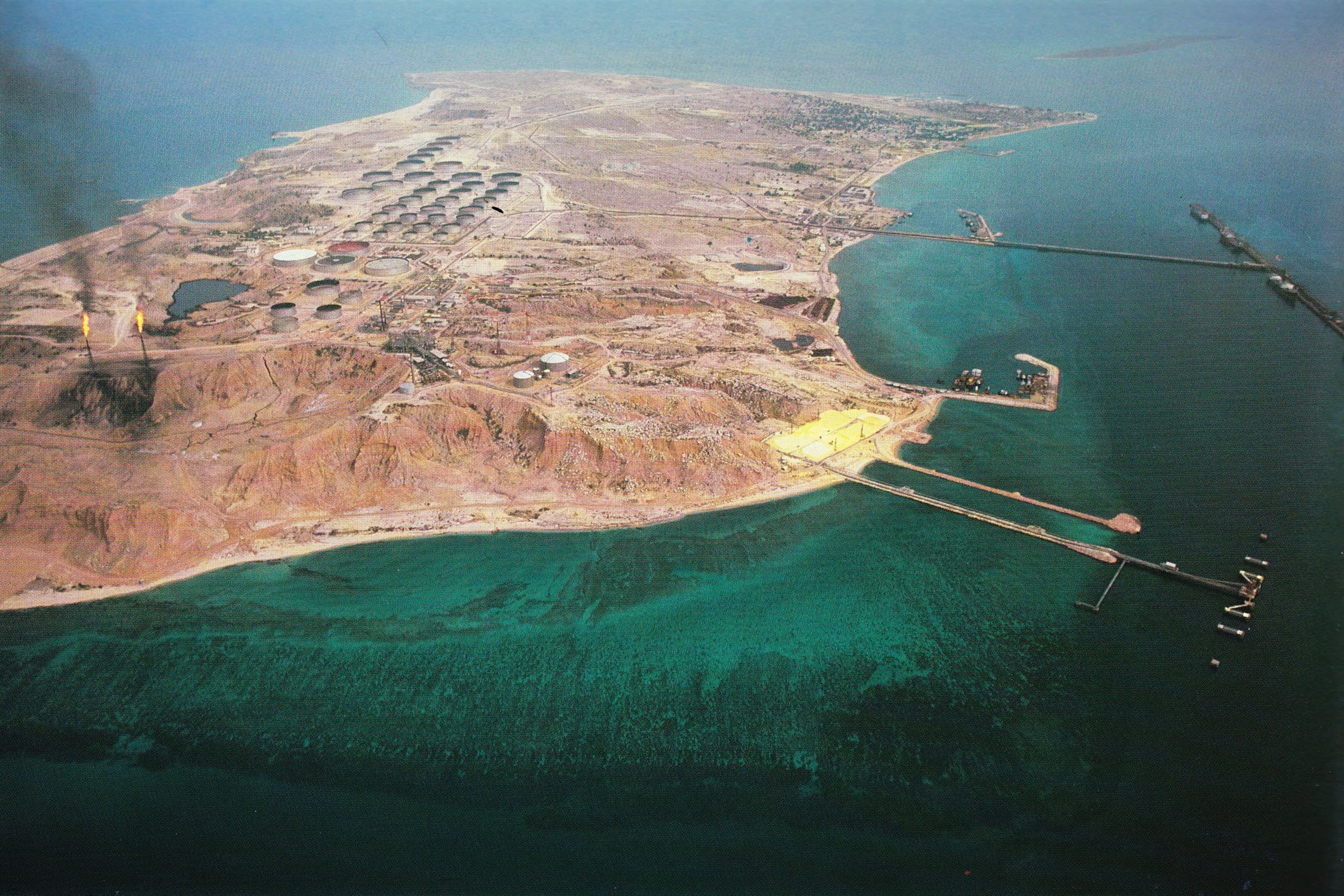
Khark island, Iran (1973)
ISSN 2818-9434
Kharg was a terrifying island; it was as if some monstrous being had cradled a massive slab of rock in a wide, slack sling, whirled it wildly above its head with no destination in mind, and then, with a single violent release, sent it flying—until fate cast it down into the Persian Gulf. As far as the eye could reach, the island lay encircled by water; at dawn the sun lifted from one edge of the sea, and at dusk it slipped beneath the waves on the opposite side. All the way to the horizon—where earth touched sky—everything glimmered blue. There was nothing but water, nothing to behold but the sea. “Exile on Kharg” Enjavi Shirazi, pp. 32–33
If we set aside the long and tumultuous history that Kharg has endured, the island acquired a distinct status during the reign of the second Pahlavi—both because of the political authority asserted by the state and because of the dominance of oil, the “black gold” of the modern age. On one side, Kharg became a place of exile for political opponents of the regime, particularly between 1946 and 1958, serving primarily as a site of banishment for leftists and members of the Tudeh Party. On the other side, with the discovery and expansion of oil operations, Kharg was transformed into the Pahlavi state’s “treasure island,” capable of financing Mohammad Reza Shah’s dreams of building a “modern” Iran.
Kharg’s natural geography—nothing but hardship and affliction for the exiled—was, for the Pahlavi state, a natural asset: a means of consolidating its economic and political power. Before Kharg became an island of oil and industry, it was a remote outpost on the margins of the Persian Gulf whose harsh and unforgiving climate made it a natural prison, a place to which political dissenters were banished. The scorching heat and lack of basic living conditions constituted a punishment in themselves—a punishment that cost the government virtually nothing. Neither the disciplining of the exiled nor the sustenance of their lives required state expenditure; both burdens were left to the island’s nature.
After 1958, as oil grew central to the national economy and industrial infrastructure was needed for its extraction and export, Kharg shifted from a place of exile to a pivotal hub in the oil industry, transforming from a peripheral site into a key locus of the Pahlavi modernization project.
This review considers four texts on Kharg Island written between 1946 and 1966 to trace its two-decade transformation: two exile-era notes—by Enjavi Shirazi, journalist and cultural scholar (1921–1995), and Karim Keshavarz, writer and member of the Tudeh Party Central Committee (1918–1986)—which depict the island from the perspective of exiles’ lived experience; and two monographs—by Jalal Al-e Ahmad (1923–1969), a prominent intellectual, and Khosro Khosravi (1927–2015), sociologist and university professor— which examine Kharg’s social, cultural, and economic transformations by oil export, characterized by the introduction of heavy machinery, transformation of the island’s natural environment and demography.
Enjavi Shirazi: The Exile of Kharg
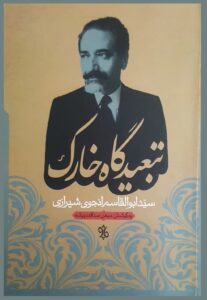 By September 1941, following the fall of Reza Shah, Abolqasem Enjavi Shirazi—still a university student engaged in journalism and political activities—assumed that the period of great terror had ended. However, his critical periodical, Atashbar, was shut down and permanently revoked. In 1948, as political conditions worsened after the failed assassination attempt on Mohammad Reza Shah, he left the country to visit Hedayat in Europe. He went to Geneva in 1950 to continue his studies in political and social sciences and returned to Iran during Mosaddegh’s national government. By the 1953 coup, he fell under suspicion and was arrested—initially imprisoned in the Armored Division prison, and after several months, sent to Kharg Island.
Enjavi’s daily notes from Kharg, later published as The Exile of Kharg, chronicle his two-year exile (1953–1955) on the island. In these notes, his portrayal of Kharg goes beyond that of a mere place of exile, depicting it as a site of solitude, waiting, and reflection, where the humid winds and waves of the Gulf never rest and constantly disrupt the order of life. The island forces you to pause and to stand firm facing yourself with anxiety and hope.
In Enjavi’s description, life on Kharg passes in waiting. You simply wait—wait for the end of exile, for return and as time stretches endlessly, the waiting becomes life itself; Enjavi writes with calmness, yet tinged with bitterness, that on Kharg even “open air” is available only in small degrees, and it is precisely this “smallness” that becomes significant: a little wind, a little light, a little silence. He notes that Kharg’s land is almost devoid of vegetation, covered in sand and stone, and that the humid southern winds blow so strongly that breathing becomes difficult.
Yet for Enjavi, this is not the whole of Kharg. He also speaks of the “patient beauty of the island”: the silence that rolls across the noontime landscape, and the sea that at night “shines like a black mirror” beside the camp where the exiles live. Time and again, he uses Kharg’s nature as a metaphor for exile itself. Just as the island is isolated in the middle of the sea, the exiles are cut off from society and left distant.
Karim Keshavarz: Fourteen Months in Kharg
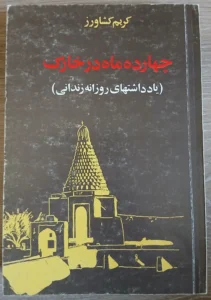 Karim Keshavarz’s daily notes from Kharg share the tone and some stylistic elements with those of Enjavi, yet they differ in significant ways (Both were exiled on Kharg at the same time). Fourteen Months in Kharg is part of the broader tradition of leftist political memoir-writing in Iran, yet Keshavarz’s depictions of the landscape, natural environment, and daily life in exile render the text a realist work that occasionally takes on a poetic quality, occupying a space between reportage and personal reflection.
Kharg’s harsh and barren environment is depicted as a stage where human beings confront the untamed forces of nature: the stifling heat, scarcity of fresh water, briny winds, and the sensation of being “hemmed in by the sea.” Yet Keshavarz writes with a sense of wonder and respect for the island’s raw, untouched landscape. In several passages, he highlights the tranquility of the nights, the silence of the shore, and the flight of seabirds as the sole signs of freedom.
In the opening pages of his diary, Keshavarz describes the hardships of life on Kharg with the meticulous attention of a social observer: the oppressive heat that makes breathing difficult, the scarcity of fresh water, and the complete vulnerability of humans before the sun and sea. He observes that with each sunrise, “the heat storms down from both the sky and the ground,” and that shade exists only in the improvised shelters the exiles construct from cloth and wood. In these passages, Kharg’s natural environment is not a mere backdrop but an active, compelling force.
Keshavarz notes that roughly 120 exiles inhabit the Kharg camp, most of them frail and weakened, their exhaustion intensified by the scorching heat. No one has the energy to speak; talking in this remote “hell,” he observes, is a mistake—something only the inexperienced fail to understand. Those who quarrel during the day or wander about half-naked are the newly arrived exiles who, as Keshavarz put it, have not yet spent a sleepless night from the searing pain of sunburn. During the day, seizures and fainting spells have become so frequent among the exiles that “we’ve lost count, and the small infirmary has no space left for even one more patient.” The pervasive fear that anyone might be an informant has made trust and close companionship nearly impossible. Some prisoners—especially the younger ones—have coarse tempers and indulge in crude talk about women, girls, and sexual relations, making the blazing sun more tolerable than their company. The best remedy for surviving this place of torment, he writes, is reading books and magazines—of which, surprisingly, there are not too few—and walking by the sea when accompanied by a gentle breeze.
While Keshavarz does not dwell on the violent climate of Kharg, he occasionally alludes to the island’s hidden beauties. He finds Kharg’s nights—especially after the fierce sun has subsided—full of silence and reflection. These natural elements create a sense of place in his notes that goes beyond mere geographical description. Ultimately, Kharg appears to him as a double image: it is “the most remote point in Iran” (a site of suffering) to which the state sends its exiles, and at the same time, an island—a cell in the body of the Persian Gulf—where the boundary between land and sea, homeland and exile, is constantly shifting. Viewed through this lens, Kharg becomes part of Iran’s emotional and cultural landscape rather than a camp for political exiles.
While Enjavi’s text treats exile as a literary and mystical journey—the exiled as a wayfarer—Keshavarz remains firmly rooted in reality. As a leftist political activist and intellectual, he adopts a documentary and socially grounded perspective. He observes the collective life of the exiles, who are compelled to live together despite their clashing temperaments, and documents the island’s many shortages—from food and medicine to fresh water, which, even when available, is unbearably warm. He examines these conditions through the spatial organization of the camp, a site regarded by the rural population as an ill-fitting appendage to the island, as well as through the conflicts and tensions among its residents. For Keshavarz, Kharg is not only a metaphor for the inner world of the exile but also a concrete example of a disciplinary and punitive camp society.
While Keshavarz’s text contains layers of ethnographic and geographic observation—recording details of the climate, lived spaces, relations between exiles and guards, and everyday interactions with the natural environment—it is not a sociological analysis or scholarly monograph in the strict sense. Fourteen Months in Kharg, like Enjavi’s text, constitutes an unintended ethnography: descriptions produced from within the experience of exile that, though memoiristic in form, possess monographic value due to their engagement with social and environmental realities.
Jalal Al-e Ahmad: Kharg Island, the Gulf’s Orphaned Pearl
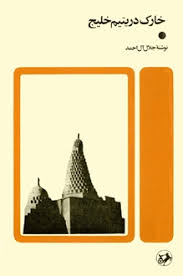 In Kharg Island, the Gulf’s Orphaned Pearl (1960), Jalal Al-e Ahmad, with his incisive, forceful, and deeply personal prose, delves into Kharg as a ‘miniature world,’ capturing its intricate social and cultural landscape.
He travels to the island as an observer and critique its industrial expansion and evolving labor relations, at a moment roughly five years after oil development began. In his account, Kharg serves as a showcase for the dilemmas of Iran’s oil modernity—a place where the logic of modern capitalism produces a tense and volatile environment which unsettles maritime livelihoods, local customs, and indigenous belief systems.
His framing recasts the narrative as a social and cultural monograph that captures the contradictions of Iranian society in microcosm, moving far beyond the conventions of a travelogue. Kharg becomes a distilled image of an Iran in transition— a site where all the frictions between old and new, humans and nature, labor and domination can be observed within a limited yet meaningful space.,
He reads the island’s climate in direct relation to human life, rendering it through ethnographic detail. The scorching heat, humid Gulf winds, scarcity of fresh water, and saline soil are not merely natural features but formative forces that shape the character and temperament of the island’s inhabitants. The tension between sea and land, the faint greenery of date palms set against chalk-white cliffs, and the unbroken horizon all underscore how the Persian Gulf’s natural environment imposes a “persistent hardship” on life. Yet he detects signs of indigenous adaptation to this hardship—a capacity he highlights in his other works as well, from Khesī dar Miqāt to Nūn va al-Qalam.
Al-e Ahmad’s tone in this text is sharper than in his other monographs, such as Awrāzān and Tāt-nešīnhā-ye Bolūk-e Zahrā, where he largely documents the gradual transformation of a small socio-economic and cultural unit in the modern era. Here, by contrast, he examines its erosion and disintegration. He begins by noting that Kharg is moving toward wealth and prosperity—toward modernization—ushered in by oil and its astronomical revenues. The port, he observes, can fill the “monstrous belly” of 100,000-ton tankers in less than half a day. The oil itself travels through a pipeline stretching from Gachsaran to Kharg, coursing across mountains and plains to Genaveh before running underwater to the island. Securing these pipelines, overseeing oil exports, and servicing supertankers require a complex network of facilities, transforming Kharg into an international port. He also predicts that Genaveh will prosper similarly, providing labor across the expanding sectors of the oil industry. Al-e Ahmad recounts his conversations with oil workers, divers, and company guards throughout the text, and through these closely observed encounters, he constructs a vivid portrait of inequality and class division on an island shedding its old identity—Kharg remade by oil, yet marked by widening social fissures.
The presence of foreigners and the new industrial order is depicted as a form of neocolonial rule, replacing indigenous modes of work and local livelihoods with wage labor and exploitative mechanisms in the Persian Gulf. Yet his prose never becomes dry, purely reportorial, or overtly polemical; instead, with a literary style enriched by sociological insight and philosophical undertones, he examines the tensions between “labor and idleness,” “industry and the silence of the sea,” and “development and human exhaustion.”Bottom of Form Beyond a monograph on Kharg, the text conveys the existential crisis faced by Iranians in encountering modernity—a thoroughly material transformation that disrupts all aspects of life and embodies what Al-e Ahmad terms “rootless development”—a form of progress imposed externally by the power of oil, rather than arising organically from within society.
Oil courses through the island like a black vein, transforming everything—from language and modes of labor to domestic architecture and the very rhythms of daily life. The relentless force of bulldozers brought the island to its knees: houses and palm trees that stood in the way of roads, airports, and docks were leveled. Local livestock became impediments as well.. Palms were cut down, homes demolished one by one, and their owners were placated with modest compensation to make way for guesthouses, restaurants, shops, swimming pools, sports clubs, dormitories, and tennis courts. The locals, developing a taste for English “talk,” new manners, and foreign foods, gradually abandoned their own heritage, becoming obsessed with Western ways (farangi-mābi).
This encounter between the modern world and the island’s isolated life mirrors Iran itself, caught in a violent storm of change while trapped within its own internal contradictions. He calls Kharg the “Gulf’s Orphaned Pearl” to capture this tension. Yet the lives and minds of the islanders are transforming: new economic relations are taking hold, and signs of consumerism are emerging. Hands reach more easily for the mouth; today, every household possesses a fan, refrigerator, radio, or wheeled cradle. The locals, now wage laborers, feel “optimistic” about a future they expect to be even “better.”
Yet for the author, these transformations remain superficial; they are not truly ours. He argues that the issue is not mere “change,” nor industrialization or mechanization—which are inevitable in the new century—but when these transformations are superficial and achieved by mimicking others, they bring decay rather than progress. Let us not forget that in this country, “out of its fifty thousand villages, half still do not know what a match is.” In the silence of the Gulf—a space for reflection and reconsideration—Al-e Ahmad hears the echo of a question that reaches far beyond Kharg itself. In the face of imitation, reliance, and subordination, how can one maintain one’s identity and heritage?
Khosrow Khosravi: Kharg Island under the Reign of Oil
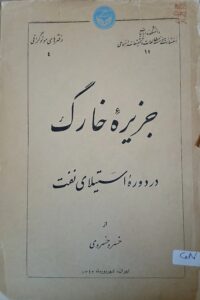 Kharg Island under the Reign of Oil is one of Iran’s earliest and important sociological monographs, which examine how the oil industry reshaped local geography, social relations, and economic structures of an island. It was published in 1963, at the height of the expansion of oil industrial projects in the Persian Gulf. Unlike Al-e Ahmad or Enjavi’s largely reflective works, Khosravi uses classic monographic methods—field observations, interviews with workers and oil company staff, and analysis of economic and environmental data—to show the profound impact of oil and industrialization on life on the island.
The first and second sections of the book examine Kharg island as a geographical unit. This is followed by a study of the “social system” of the island, in which humans, labor, and nature take on new forms of life in connection with the oil industry. Accordingly, the structure of the book moves from descriptions of the climate and environment to the demographic composition and settlement patterns of Kharg, then to the island’s local society and its social and cultural characteristics, and subsequently to labor economics and class inequalities formed under the rule of oil company. The book concludes with an analysis of the cultural and psychological consequences of these transformations.
In describing the island’s climate, Khosravi shows that prior to the arrival of the oil company, life on Kharg was organized around the sea, fishing, and limited local trade. With the onset of oil extraction and transport, the island’s natural ecology could no longer sustain sea-based livelihoods; in the emerging industrial environment, both land and sea were subordinated to the logic of oil extraction. Khosravi explores how oil created a rupture in the human-nature relationship within the maritime ecosystem and explains how island’s historical social structure collapsed as oil company took the lead: local fishermen and seafarers became industrial workers, the local subsistence system gave way to wage labor, and new forms of inequality emerged between local employees and foreign staff or new technical labore. In his words, oil created “a centralized nexus of economic and administrative power,” thereby transforming the small community of Kharg into a microcosm that reflected the broader contradictions of oil-dependent Iran under the accelerated and authoritarian modernization under Mohamadreza Pahlavi.
In the middle and final sections of his book, Khosravi shifts his focus from the economy to culture. In his view, the arrival of oil was accompanied by a form of cultural and psychological colonization: the comings and goings of foreign engineers and managers, their modern and consumerist lifestyles, and the gap between “Iranian workers” and “a technical system coming from the West” all exemplify the symbolic domination of oil-driven modernity. He highlights the expansion of feelings of powerlessness and alienation among the island’s local population, as well as their sense of being secondary and inadequate compared to Westerners—a phenomenon that would later be theorized on a larger scale in Iran during the 1970s under the frameworks of “neocolonialism” and “dependency theory.” Khosravi argues that the oil industry and Kharg cannot be studied solely from an economic perspective or as industrial development aligned with modernization projects and their material outcomes (as government-affiliated research institutions tended to do). Rather, oil must be analyzed as a decisive factor in power relations, identity formation, and spatial transformations within the socio-cultural fabric of southern Iran. For Khosravi, Kharg is a microcosm: a small-scale example of a society under the heavy shadow of oil modernity, rapid industrial development, and dependence on the global economy.
Beyond its sociological research, Khosravi’s monograph articulates an ethical concern, one that Ehsan Naraghi and Shapour Rasekh also address in their introductory note to the book; It offers a warning about a society shaped by rapid material transformation under the oil industry, one that becomes simultaneously richer and poorer as material progress, indifferent to social and cultural concerns, coincides with the erosion of heritage.
Conclusion
This review of the four texts on Kharg reveals the exceptional and rapid transformation of the island that, due to its harsh, arid climate, was initially the habitat of marginalized local communities and a site of exile for political prisoners. As surrounding oil fields were developed, the island became one of the country’s—and the world’s—largest oil export terminals, capable of docking multiple supertankers simultaneously.
The study of Kharg over time served as a site for social-scientific imagination and reflection in Iran, across genres including memoir, monograph, and social analysis, linking space, climate, and indigenous traditions with oil-driven modernity and industrial development within the framework of rapid, authoritarian state-led modernization. In the 1950s, these social reflections were primarily humanistic and political in nature, but by the early 1960s, oil had become the central focus of reflection on Kharg. As material transformations reshaped the island, intellectual reflections shifted from the politics and living in exile to questions of foreign domination, industrial development, exploitation, and alienation.
Kharg became a terrain for theoretical inquiry for Iranian social researchers: Al-e Ahmad analyzed its social, cultural, and ethical transformations as a crisis of identity and dependency, while Khosravi examined it through sociological lens of power relations, new labor arrangements, and socio-economic changes. The island transformed from a symbol of exile and human isolation into a symbol of oil-dependent Iran. Enjavi and Keshavarz delve into the “inside,” revealing the lived experience at the boundary of nature and human life, while Al-e Ahmad and Khosravi observe it from the ‘outside,’ as a microcosm of a modernizing society, full of tensions and contradictions. Thus, the trajectory of writing on Kharg moves from exile memoirs and literary diaries to oil sociology: from individual suffering to social critique of power structures and the political and its political-economic foundations.
References
Enjavi Shirazi, Seyyed Abolghasem. 2005. Tabidgāh-e Kharg [Exile on Kharg]. Edited by Mihan Sedāqat-Pisheh. Tehran: Chāv Publications.
Āl-e Ahmad, Jalāl. 1960. Jazire-ye Kharg, Dorr-e itīm-e Khalīj [Kharg Island, the Gulf’s Orphaned Pearl]. Tehran: Dar-e Rāh-e Dānesh Publications.
Khosravi, Khosrow. 1963. Jazire-ye Kharg dar Dowre-ye Estelā-ye Naft [Kharg Island under the Reign of Oil]. Tehran: Institute for Social Studies and Research Publications.
Keshāvarz, Karim. 1984. Chahārdah Māh dar Kharg [Fourteen Months on Kharg: Prisoner’s Daily Notes]. Tehran: Payām Publications.
Related Content
 GlobIS Review, Volume 2, Issue 2 (©Background)
  New Horizons in Persian Gulf Studies (©Background)
  Golestan According to Oil (©Background)
  The Identity Politics of a Body of Water: On Persian Gulf Studies in Iran (©Background)
  Documenting Sea Change in the Persian Gulf (©Background)
  On the Uses and Disadvantages of Exile and Diaspora for Iranian Studies (©Background)
Comments are closed.