Golestan According to Oil (©Background)
ISSN 2818-9434
 There has been a renewed interest in revisiting Ebrahim Golestan’s early documentary films about oil. This is in part due to the current focus on the historical ties between extractive industries and their contribution to the global media culture in the 20th century.[1] The turn toward the energy corporations’ expansive array of cinematic and photographic production and their remaining archives has played a crucial role in rethinking the relationship between cinema and oil, and how each constituted the dreamworlds of modernity by their distinct magic. While the film oeuvre of Ebrahim Golestan has always held a special place in the Iranian cinema, examining the link between the political economy of oil and the cultural infrastructures of oil in shaping the careers of pioneering figures within the Iranian New Wave cinema, with Golestan as a canonical example, is a recent focus. Ebrahim Golestan is an eccentric figure in the history of Iranian cinema, his personality and celebrity status often created an aura through which his films were interpreted and perceived. In a reverse act, I propose to consider oil as an analytical optic through which we can reframe a new portrait of Golestan, not simply as a filmmaker with several commissioned films about oil, but as a figure who was symptomatic of Iran’s encounter with modernity. From this perspective, oil can help us see Golestan differently and understand how modernity was translated and reflected upon within the cinematic registers of the Iranian New Wave movement.
As Farbod Honarpisheh (2016) suggests, the Iranian New Wave cinema (1960-1979) “showed an ethnographic register,” which first emerged from within the documentary mode and flourished in Iran from the 1960s. During this critical period, observational and essay documentary films functioned as a form of social ethnography addressing issues of gender, religion, and class across the Iranian society. For example, Kamran Shirdel’s Women’s Prison (1965) and Tehran is the Capital of Iran (1966), and Nasser Taghvai’s Wind of Jinn (1969) offered critical counter-narratives to the official portrayal of Iran’s national development. Golestan’s oil documentaries were also part of this early cinematic portrayal of Iran’s changing landscape amidst its rapid petroleum-fueled modernization. Honarpisheh locates another important dimension to this cinematic movement, and that is the parallel cultural and art-related institution buildings that came with the flow of oil revenue (Ibid). The experience of modernity in Iran during 1960s had a particular affinity with screen culture, owing to the fact that different foreign states and their local attaché offices, central government, and national cultural institutions increasingly funded film commissions and art festivals (Naficy, 2011). This institutional dimension is an important aspect behind how the social imaginaries of oil were inscribed through the cinematic language of Iranian New Wave.
Following the oppressive and politically homogeneous period after the nationalization of oil in Iran, the filmic culture began to challenge and grapple with the ideas and ideals of modernization. The cinematic “counter-visualities” (Mirzoeff, 2011) of the Iranian New Wave cinema, extended both the realm of the real and the imaginary through different visual and literary allegories. Characterized by Hamid Naficy (2011) as the “cinema of dissent” or the cinema of “counter-modernity” by Ali Mirsepassi and Mehdi Faraji (2016), the films produced in these two decades were highly self-reflective of the unequal experience of modernity brought by the flow of petrorevenue, functioning as “imaginative surrogates” for an alienated society unsure of its own image (Idid, 398). As Farbod Honarpisheh (2023) observes, there is a recurring fascination with the idea of ruin and ruination in the films produced in the New Wave alluding to this social alienation. He explores how the lyrical ethnographic documentaries produced in this period have been shaped by two main artistic representations: the ruins and the anguished bodies. Viewed this way, it becomes evident that the material and conceptual connections between artistic depictions of built structures and bodies afflicted by decay, disintegration, ruination, and disease, are recurring themes in the Iranian New Wave. Similarly, but different in its intensity, the historical trajectory of ancient sites and material decay is also present in some of the oil documentaries that Golestan directed such as Wave, Coral, Rock (1962).
Fresh in the aftermath of the American and British coordinated coup d’etat in 1953, Golestan was commissioned by the consortium to produce a film about the oil industry, directing his first oil film titled From a Drop to The Sea (1957), produced by the Iranian Oil Operating Companies. From a Drop to The Sea stands out as a conformist film compared to Golestan’s future films about oil, following the same narrative tropes of portraying the modern versus the non-modern visions of Iran, repeating the story of oil’s futurity set against the tribal backwardness it is bound to eradicate. Narrated in English, the film starts with the portrait of a woman dressed in what seems to be traditional Bakhtiari attire, standing on the ruins of a fire temple; as the camera pans, we see the sprawling industrial facilities and what seems to be the oil company’s headquarters down the mountain hills in Masjid Suleiman. The film’s opening scene is reminiscent of the official photographic albums produced by the Communications and Public Relations department of British Petroleum (formerly Anglo-Iranian Oil Company). These highly curated albums consisted of their own narrative sequences, often starting with a few photographs showing the fire temples or ancient ruins, sometimes as abandoned archeological remnants and at times with staged scenes of Bakhtiari women or men standing on rocks. Frozen in time, the local Bakhtiari tribes were often used to illustrate the ancient backdrop against which modernity could show its necessity. These orientalist myths were heavily utilized by the British in their cinematic and photographic depictions of their extractive operations in Iran.
From a Drop to The Sea depicts the path of oil from its ancient symbolism in fire temples to its present-day geological probing and seismographic tests, finishing its journey by arriving to its consumer markets in Europe. This cinematic portrayal was very common among the oil documentaries produced in this period. In 1967, Italian director Bernardo Bertolucci directed a three-part documentary titled La via del petrolio (The life of Oil) sponsored by the Italian oil company ENI. In a similar narrative style, La via del petrolio also paints an origin story centered around oil’s material journey, starting with Iran and concluding in the European continent.
Energy corporations such as BP, Shell, and ENI utilized the cultural power of cinema by establishing film units, constructing cinemas, and sponsoring fiction and non-fiction films. As Mona Damulji (2015) has described the proliferation of “petro-films,” documentary and corporate films commissioned by oil companies in Iran and Iraq, were used not just to record oil infrastructure but to actively shape perceptions of modernity, urban space, and social life around oil. Different in their approach and corresponding to different geopolitical moments and geographical contexts, these films are now crucial entry points into dissecting the cultural and political registers of petromodernity during the 20th century. The national successors to BP in Iran, the National Iranian oil Company and the Iranian Oil Companies Operations, also heavily utilized film and print publications (monthly magazines and periodicals) to promote their own national vision of oil. The flow of petrorevenue enabled film sponsorship by different cultural institutions that saw cinema as an archival tool that could document the disappearing tribal culture across Iran. Iran on the Move (1966) is a testament to this ethnographic impulse. A relatively unknown film, Iran on the Move is a documentary produced by Studio Parsfilm and co-sponsored by the Ministry of Information & Tourism and the Iranian Oil Companies Operations, showcasing the family traditions of four different nomadic tribes across Iran, including Qashqai, Bakhtiari, Kurdish, and Turkmen tribes. Iran on the Move was in fact the English version of the film Tribes of Iran (1966), which was narrated in Persian. Revisiting this diverse array of petrofilms paints a more complex image of the role of cinema in grappling with the lived experiences of oil in Iran.
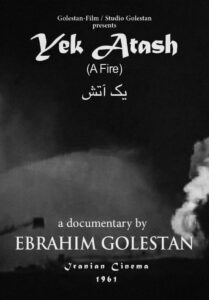
There is a direct link between the flow of oil and the proliferation of documentary films in the Iranian New Wave. The establishment of Golestan Film Studio in 1958 can help us trace this connection tangibly.Writing on the importance of Golestan Film Studio’s influential 10-year operations, Ehsan Khoshbakht (2016) explains its critical influence in shaping the career of many young artists and cultural workers of that period, many of whom continued to appear in the future films of Golestan. Golestan Film Studio produced two important oil documentaries of Golestan, A Fire (1961) and Wave, Coral, Rock (1962). Looking at these two films closely can help us dissect the career-shaping influence of oil’s economy in that period and the ethnographic constructions of land, labor, and gender relations that were developed in these early oil documentaries produced by the Golestan Film Studio. In recent years, A Fire has received a revived attention as a unique portrayal of environmental degradation imposed by the violence of extraction. However, reading A Fire in relation to Wave, Coral, Rock can help us see a broader trajectory in the role of oil in shaping Golestan’s allegorical language. It is also crucial to mention that both films have two versions, with Persian and English voice over. In both cases, the English versions have been circulated the most. However, there is a stark contrast between the Persian and English versions of these films in their use of poetry and literary influence which is noteworthy. My reading of these films is based on the Persian versions.
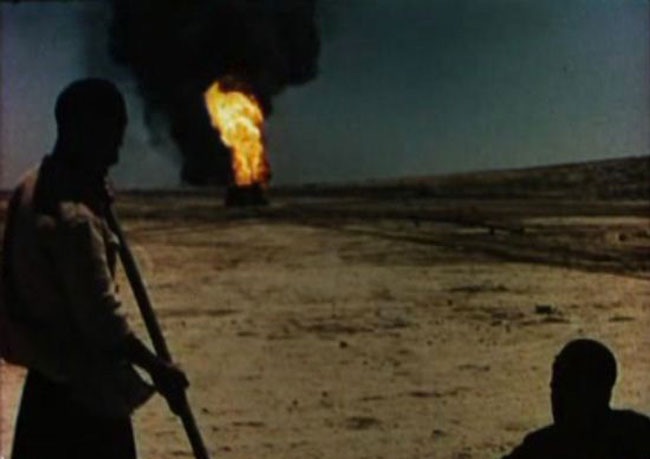
A Fire stands as a clear contrast to From a Drop to The Sea, offering a more nuanced ethnography of the social life disrupted by an oil well fire as the camera observes the fire until it is extinguished. A Fire is a documentary portrait of the extractive violence inflicted upon local citizens and the labor force near an oil well in Ahwaz, who had to endure the unbearable ecological rupture of an excruciatingly long and dangerous oil well fire that lasted for nearly 65 days. The duration of the film is defined by the fire; an aberration in the traditional attempts to paint a seemingly complete portrayal of oil’s journey as we see in From a Drop to The Sea or La via del petrolio. Instead, it becomes a portrait of an interrupted life alongside the oil well fire. A Fire was filmed by Golestan’s brother Shahrokh Golestan and edited by Forough Farrokhzad, as her first editing experience, which served as a prelude to her breakthrough film titled The House is Black (1963) two years later. Perhaps this nuanced approach is the direct influence of Farrokhzad’s intricate editing that blends the sound of a mother’s lullaby with sounds of explosions, interweaving the domestic and the industrial in an intimate frame.
Commissioned by the Public Relations department of the Petroleum Ministry and funded with a generous budget, Wave, Coral, Rock (1962) is divided into roughly three main narrative sections. The first part of the film is focused on the construction of oil storage tank farms in Kharg Island, the second part moves to the expansion of the oil fields and construction of oil wells in Gachsaran, and the third part follows the construction of pipelines from mountainous regions of Gachsaran to the shorelines of Kharg Island. The film starts with a montage of ancient ruins and decayed brick structures across the Kharg Island accompanied by a poetic essay as a voice over by Mahmoud Hangwal. This opening scene shows a clear resonance with the opening scene of The Hills of Marlik (1963), also narrated by Mahmoud Hangwal, which also relies on prose poetry to explore the concepts of ruination, passage of time and the historical transformations of the land. After the montage of ancient ruins comes to an end, an airplane arrives, a local woman wearing a Battoulah, pauses with hesitations, recognizes the airplane landing, and places the clay water carrier on her head as she walks away. Like From a Drop to The Sea, this scene relies on juxtaposing the modern and non-modern ways of life and alludes to the social amenities offered by petromodernity’s arrival on the abandoned island in ruins.
Wave, Coral, Rock utilizes a wide array of cinematic and directorial choices that might seem eclectic.This includes scenes that are scripted and acted. For instance, it shows oil workers in their domestic spaces, embarking on their daily work in the morning and leaving their children behind. At times the film relies on rhythmic montage of industrial sound and images, while it also brings allusions to dialectical montage to create tension. In the first section of the film, there is a particular emphasis on the corporeal body of the oil workers, engaged in heavy physical activities such as wrestling and traditional lifting. The camera transitions into a peculiar moment that depicts the workers’ bodies in a close-up, unloading a truck full of what seems to be slaughtered sheep, as the animal meats are thrown and piled up by the oil workers. The camera stops when an oil worker holds the corpse of a sheep close to his body and starts laughing incessantly. The film then cuts into an aerial view of the oil storage tank farms, implying the corporeal cost and the human energy behind the colossal expansion of these modern infrastructures. As evident from this scene, the film has an eclectic use of symbolism in its imagery, and it is unclear whether it is a nuanced criticism towards the oil industry or is simply an intellectual exercise for Golestan.
Furthermore, it is noteworthy to mention that some literary and film figures such as Jalal Al Ahmad and Bahram Beyzai criticized Golestan for Wave, Coral, Rock and questioned whether such commissions were the right political decision to make by a filmmaker when extractivism’s rippling effects were felt across the Iranian society.[3] Meanwhile, the ending of the film has often been referred to as Golestan’s attempt in vocalizing his critical voice. The film concludes with the successful flow of oil in the pipelines from Gachsaran’s oil fields to the Kharg Island’s oil terminals where they will be loaded for their next destination. While showing the aerial views of the oil depot, the voice over declares that “one million and two hundred thousand days of human labor” was spent for this colossal operation. As the camera shows the foams created by the crushing waves with an oil tanker departing in the background, the narrator ends the film with the following sentence: “And the kingdom of the resting pearls, the corals and the fish entrusted to fate, received no other fate than this foamy furrow.”
Reflecting upon Golestan’s oil documentaries, I wonder what did these films do back then, and what do they do now? They are crucial archival documents from the tumultuous encounter with petromodernity in Iran, revolving around a single commodity that has defined the political and economic fate of Iran in recent decades. The films reveal how ambiguous it can be to make a documentary, commissioned by an oil company, about the extractive process of probing, extracting, and exporting of oil to foreign consumer markets, while attempting to retain a critical and personal voice. Considering the ethnographic gaze of some of the films and the positionality of Golestan, I am often occupied with the following question: whether Golestan’s camera allowed the subaltern to speak? How is the top-to-down gaze reproduced in these documentaries but this time with a national camera and by an Iranian film crew? I approach these films as a filmmaker who has re-used and re-purposed them in my own films as archival “image banks” (Russell, 2018), with the aim of mapping out the ruptures and continuities between the colonial and national image regimes of oil. Even though this piece is particularly aimed to unpack Golestan’s cinematic registers of oil, it is important to mention that other influential filmmakers of the Iranian New Wave also made commissioned documentaries about the oil industry. These include: Manouchehr Anvar’s Cham Project (1962), Manouchehr Tayab’s Abadan (1972), and Kamran Shirdel’s Gas, Fire, Wind (1986), and Tarhe Genaveh (1988). The substantial number of these oil documentaries is another testament to the impact of petromodernity on screen culture within the Iranian cinema.
Writing on the history of oil in Venezuela, Fernando Coronil (2004) suggests that “images do not so much show history as provide a site for struggle over its meaning.” As clues to the history of oil in Iran, Golestan’s films are “sights/sites that reflect and refract the social contests over meaning that give rise to them.” Coronil’s view on the social life of images can help us dissect Golestan’s film, and wrestle with their meaning, in their past and present lives. These films do not necessarily “show” the history of oil in Iran, but as it is evident in the films discussed above, the images themselves become the location to wrestle with the political life of oil in Iran and how its cultural and media infrastructures shaped the contours of Iranian documentary cinema during a crucial period.
References
Coronil, Fernando, 2004. “Seeing history.” Hispanic American Historical Review 84 (1): 1-4.
Damluji, Mona. “The image world of Middle Eastern oil.” In Subterranean Estates: Life Worlds of Oil and Gas (2015): 147-64.
Ehsan Khoshbakht, 2016. “Golestan Film Studio: Between Poetry and Politics,”
Honarpisheh, Farbod, 2016. “Fragmented Allegories of National Authenticity: Art and Politics of the Iranian New Wave Cinema, 1960-79,” (PhD diss., Columbia University).
Mirsepassi, Ali and Mehdi Faraji, 2017. “Iranian Cinema’s ‘Quiet Revolution,’1960–1978.” Middle East Critique 26(4): 397-415.
Mirzoeff, Nicholas, 2011. The Right to Look: A Counterhistory of Visuality, University Press, Durham, NC, USA.
Naficy, Hamid, 2011. A Social History of Iranian Cinema, Volume 2: The Industrializing Years, 1941–1978. Vol. 2 Duke University Press.
Russell, Catherine. 2018. Archiveology: Walter Benjamin and Archival Film Practices. Duke University Press.
Notes
- Priya Jaikumar and Lee Grieveson, “Introduction to Media and Extraction: On the Extractive Film,” https://mediaenviron.org/article/123925-introduction-to-media-and-extraction-on-the-extractive-film ↑
- https://www.tribunezamaneh.com/archives/7801 ↑




Comments are closed.