When Categories Cease to Explain: Political Science and the Middle East after the Arab Uprisings (©Background)
Book Review | Reading Time: 13 minutes
When Categories Cease to Explain
Political Science and the Middle East after the Arab Uprisings
ISSN 2818-9434
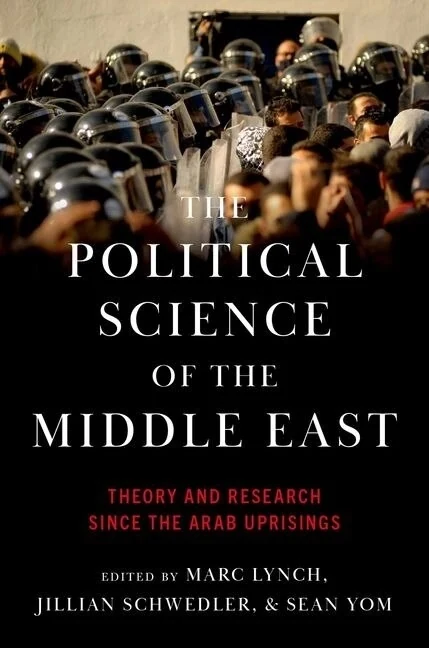
The Political Science of the Middle East: Theory and Research Since the Arab Uprisings
Marc Lynch, Jillian Schwedler, and Sean Yom (eds.)
Oxford University Press, 2022
The Arab uprisings unsettled more than rulers, alliances, and territorial orders. They unsettled the conceptual grammar through which political science had rendered the region intelligible. Authoritarianism could no longer be treated as political stillness; protest could not be sorted adequately into success or failure; sects could no longer stand in for political actors; migration could not remain a mere aftereffect of war; and the local could not be assumed to be a smaller, self-contained version of the national. The strongest achievement of The Political Science of the Middle East is to deprive these familiar nouns of their explanatory innocence. Across twelve chapters written by forty-seven authors, it recasts them as condensations of history, institutions, strategic practice, and relational power.
This is not, strictly speaking, a book about the Arab uprisings. It is a book about Middle East political science as refracted through the scholarship that the uprisings generated. Its object is therefore narrower than Middle East politics in general and more ambitious than a chronology of 2011 and its aftermath. Lynch’s introduction rejects the recurring indictment that the field had failed because it did not predict revolutions, the rise of Islamism, interstate conflict, or terrorism. The decade before 2011, he argues, had already produced scholars who combined immersive regional knowledge with stronger theoretical and methodological training, as well as public-facing institutions capable of carrying that expertise beyond the academy. The uprisings did not create this intellectual transformation so much as expose and accelerate it. They also made the region newly legible to mainstream political science not as a culturally exotic exception, but as a critical site from which questions central to comparative politics and international relations could be reformulated (Lynch, 2022, p. 5). The collection is consequently conceived as “a field-building exercise, not a scorekeeping one” (Lynch, 2022, p. 6): an effort to establish what a decade of research altered, where disagreement remains, and which questions should organize the next stage of inquiry. For an issue concerned with the “New Middle East,” this is the volume’s consequential proposition: novelty lies less in a wholly new regional essence than in the field’s capacity to rethink the categories through which change and continuity are known.
The architecture serves that purpose. After Lynch’s disciplinary history, ten thematic chapters survey the major research programs reshaped by post-uprising scholarship. Chapter 2, “Authoritarianism Reconfigured,” asks how authoritarian continuity has depended on changing forms of personalism, repression, ideological compliance, and international support; as its authors write, “Continuity, in other words, has required change” (Bank et al., 2022, pp. 35–36). Chapter 3, “Between Two Uprisings,” refuses to make immediate regime change the only measure of protest’s significance. It follows how contention reshapes participants, institutions, emotions, repertoires, and later waves of mobilization. Chapter 4, “International Relations and Regional (In)security,” treats alliances as instruments of domestic regime security as well as responses to external threats, and asks how proxy warfare and armed nonstate agency unsettle state-centered security analysis. Chapter 5, “Militaries, Militias, and Violence,” places regular armed forces and nonstate military organizations within a shared comparative frame of agency, ideology, and organization without collapsing the distinction between them.
The remaining chapters extend the same operation into political economy, religion, identity, measurement, mobility, and space. Chapter 6, “Political Economy and Development,” organizes development around inherited structures and political agency rather than historical determinism or voluntarism. Chapter 7, “Islam and Islamism,” disaggregates religion, religiosity, political organization, electoral strategy, welfare provision, and violence, refusing to let Islam function as a self-sufficient cause. Chapter 8, “The Politics of Identity and Sectarianism,” performs a parallel operation on sectarianism. Its concise insistence that “sects are not political actors” is more than a terminological correction: it requires analysts to specify whether a claim concerns particular parties, organizations, elites, or neighborhoods, and to examine the class, regional, and gender divisions concealed by collective labels such as “the Sunnis” or “the Christians” (Haddad et al., 2022, p. 190). Chapter 9, “Public Opinion,” shows how survey research became both a source of substantive findings and a methodological laboratory. Chapter 10, “Migration and Displacement,” treats mobility as constitutive of states, citizenship, and political economy. Chapter 11, “Toward a Relational Approach to Local Politics,” turns locality from a fixed territorial level into a relation produced through institutions, infrastructures, flows, and material environments. Anderson’s conclusion turns the volume back upon the discipline itself, connecting the substantive findings to field access, research ethics, academic hierarchy, and the unequal geography of knowledge production.
A Field Rewrites Its Questions
The collection enters a long dispute over the relationship between area studies and political science. Scholars of the Middle East were once faulted for descriptive particularism, weak causal inference, methodological conservatism, and insufficient presence in leading disciplinary journals. They were also attacked, from opposing political directions, either for serving Western security interests or for betraying them. The editors do not answer these charges by choosing disciplinary universalism over regional expertise. Their more consequential claim is that the strongest post-2011 scholarship joins language, history, institutions, and field conditions to methodological innovation.
That claim is persuasive not because every chapter offers a new general theory—most do not—but because the volume repeatedly changes what must be explained. Authoritarianism becomes authoritarian reconfiguration. Sectarianism becomes sectarianization and possible de-sectarianization. The apparent failure of protest becomes a question of temporal and institutional scale. State and nonstate violence become overlapping organizational fields. The local and the international cease to be self-evident levels and become relations assembled through institutions, infrastructures, and flows. The volume’s best chapters do not merely add variation to established concepts; they show how concepts themselves can conceal the politics that produce them.
This is also how the book challenges exceptionalist approaches to the region. Oil does not by itself explain political economy; rentierism has to be historicized through institutions, coalitions, class formation, and state-building. Islam does not by itself explain authoritarianism or violence; the Islamism chapter shifts attention toward organizations, participation, electoral behavior, social services, repression, and political opportunity. Sect does not by itself explain identity politics; the identity chapter examines the processes through which sectarian differences are constructed, instrumentalized, institutionalized, and sometimes contested. These are not minor qualifications; they turn “Middle Eastern exceptionalism” from a premise into a problem.
The argument also changes the periodization of the uprisings. The contributors do not treat 2011 as an absolute rupture. They reach back to Ottoman legal orders, colonial rule, postcolonial state formation, earlier protest cycles, welfare settlements, labor migration, the Iranian Revolution, the 2003 invasion of Iraq, and pre-2011 survey research. This historical reach resists the presentism that made digitally mediated mobilization, post-2011 displacement, and renewed armed nonstate actors appear wholly unprecedented. The subsequent decade also permits revision. The protests of 2019 complicated claims about societies supposedly demobilized by memories of civil war; counterrevolution exposed the limits of transition-centered analysis; and prolonged conflict revealed new forms of governance beneath the language of state failure.
Methods, Evidence, and the Conditions of Knowing
The volume is therefore best understood as an expert stocktaking rather than a collection of original empirical studies. This matters because the chapters are authoritative syntheses of research programs, not new datasets, archival studies, or fieldwork monographs. Their evidentiary strength lies in the range of research they assemble: ethnography, interviews, archives, protest-event data, election results, public-opinion surveys, experiments, social-media analysis, geospatial techniques, firm-level economic evidence, organizational studies, and interpretive work on ideology and affect. The public-opinion chapter and the political-economy chapter’s discussion of firm-level research on crony capitalism effectively demonstrate what new data infrastructures made possible. Surveys no longer merely record attitudes; interviewer effects, nonresponse, and preference concealment can themselves disclose relations of hierarchy and political fear. Firm-level research moves the analysis of crony capitalism beyond general indices of corruption to identifiable companies, sectors, regulatory privileges, and employment effects.
The methodological pluralism is substantive rather than ceremonial. Here pluralism means the use of diverse methods, the coexistence of different theoretical traditions, and the collective organization of multiple scholarly voices around shared research areas. No single technique is presented as the badge of disciplinary maturity. Locally constructed event datasets can recover protests missed by international sources, while ethnography reconstructs interactions and meanings that coding cannot register. Survey experiments can isolate response effects, but historical and interpretive work can explain why the same political term carries different meanings across settings. Geospatial methods can map uneven provision; relational approaches can trace how ports, credit, roads, food systems, municipalities, donors, armed organizations, and distant states jointly produce a locality. The strongest contributions make method answerable to the question rather than allowing available technique to decide what counts as one.
The chronological range is productive but not uniform. Most chapters take the decade after 2011 as their principal horizon, usually ending around 2020 or 2021, while moving backward when their object requires it. “Since the Arab uprisings” consequently names a common provocation more than a common periodization. Some chapters assess literatures generated directly by 2011; others reconsider research programs whose decisive developments preceded it. The difference might have been stated more explicitly, but it ultimately strengthens the volume by resisting the fiction that one event created every relevant problem.
The hierarchy of sources is not always equally clear. Peer-reviewed articles and university-press monographs form the core, but fast-moving subjects also draw in working papers, policy reports, public-facing essays, and research still described as forthcoming. Such materials are unavoidable in a stocktaking exercise written close to events. Still, some chapters move quickly between evidence that has undergone sustained scholarly testing and claims drawn from strategic commentary or provisional research. The international-relations chapter’s discussion of American decline and regional multipolarity, for example, necessarily moves among academic international-relations scholarship, policy-facing debate, and still-unsettled interpretations of US retrenchment (Darwich et al., 2022, pp. 88–90). This is not a fatal weakness. It means that the volume is strongest when it signals an argument’s status and weakest when an emerging proposition is given the confidence of a settled finding.
The book’s ethical seriousness, however, is unusually sustained. Lynch examines the pressure to conduct dangerous research for professional distinction and the distortions produced when repression channels scholars toward safer countries, safer subjects, or remote methods. Arar and her coauthors treat overresearched refugee communities, expectations of assistance, sampling bias, and retraumatization as problems of evidence as well as morality (Arar et al., 2022). Benstead, Gengler, and Robbins connect transparency to the possibility of auditing dubious or fabricated survey data (Benstead et al., 2022). Anderson extends scholarly responsibility beyond formal consent procedures to local colleagues, students, institutions, and the infrastructures that make research possible (Anderson, 2022). Access, safety, collaboration, and academic hierarchy therefore enter into the evidence itself.
There are limits to the book’s claim to comprehensiveness, but they follow in part from the method best suited to its purpose. For a field-building volume, inviting specialists to synthesize recent literature is not a defect; it is precisely how such a project becomes possible. The limitation lies elsewhere. Many contributors are leading participants in the research programs they assess, and the chapters generally do not specify how publications were selected, which languages were searched, or how conflicting findings were weighed. These are expert syntheses, not systematic reviews. That does not diminish their value as guides to major debates, but it limits claims to comprehensive coverage. Collectively, they map the scholarship most visible within Anglophone political science more fully than the wider body of research produced in and about the region.
The volume’s pluralism is also sometimes additive rather than cumulative. This is not to demand that distinct mechanisms be reduced to a single model. The more pertinent question is how they interact, when one becomes more consequential than another, and what evidence would distinguish among them. The authoritarianism chapter, for example, appropriately treats personalism, repression, ideological compliance, and international support as different dimensions of political control, but says less about how these processes reinforce or constrain one another. The protest chapter similarly brings routine contention, affect, and long-term consequences into view, although these concern different objects and levels of analysis rather than components of one explanatory framework. These are not failures so much as consequences of a field-building form designed to open research programs rather than close debates.
Structure, Prose, and Editorial Precision
Lynch’s introduction and Anderson’s conclusion perform much of the integrative work. The former reconstructs the institutional history of Middle East political science; the latter draws from the thematic chapters a wider challenge to methodological nationalism, methodological individualism, and democracy-centered political science. Between them, the intervening chapters remain recognizably part of one enterprise. Cross-references are frequent, and the collaborative architecture appears in recurring concerns with history, scale, domestic–international entanglement, field access, and the politics of classification.
The prose is generally lucid, energetic, and well suited to graduate teaching. Several chapters survey substantial literatures without becoming annotated bibliographies. The discussions of sectarianization, survey interaction, migration ethics, and relational locality are especially memorable because they formulate analytical problems rather than catalog findings. Some passages are denser, but usually for conceptual reasons. In the protest chapter, “affect” names the embodied and emotional force through which fear, anger, hope, humiliation, and solidarity shape mobilization and demobilization. In the local-politics chapter, topology and material agency push readers to think of locality not as a bounded administrative unit but as a set of relations among infrastructures, commodities, environments, state agencies, donors, armed groups, and distant centers of power. Readers unfamiliar with interpretive theory or political geography will work harder in these sections, but the difficulty is part of the argument rather than a failure of style.
Editorial precision is less consistent than the intellectual design. A small number of verifiable errors appear across the volume. Chapter 2 identifies Erdoğan’s governing party as the “Freedom and Justice Party” rather than the Justice and Development Party and dates the constitutional amendments that enabled Sisi potentially to remain in office until 2030 to April 2014 rather than April 2019 (Bank et al., 2022, pp. 39, 41). Chapter 12 refers to the Saudi crown prince as “Muhammad Bin Sultan” rather than Mohammed bin Salman (Anderson, 2022, p. 285). These errors do not affect the central arguments, but they slightly diminish the volume’s reliability as a reference work.
Iran and the Geography of the “Middle East”
For readers of Global Iranian Studies Review, the most revealing question is not whether Iran appears in the volume. It appears often. The more consequential question is the position from which it appears. Lynch recognizes the problem directly: Arab countries have frequently been treated as the natural universe of Middle Eastern comparison, while scholarship on Iran, Israel, and Turkey has remained partly disconnected because of language, divergent political contexts, and political considerations (Lynch, 2022, p. 9). The collection does not fully overcome the division it diagnoses.
This criticism should not become an unreasonable demand that every thematic chapter devote equal attention to every state. The editors deliberately rejected country chapters, and the book is organized through post–Arab Spring scholarship, which necessarily gives Arab cases a particular weight. It is also understandable that Iran appears most fully in the chapter on international relations, where it is indispensable to discussions of regional power, alliance politics, and armed nonstate actors. The question is narrower and more precise: when Iran appears, does it appear only as a force acting upon the Arab region, or also as a domestic political field and a site of knowledge production?
Iran is most prominent in Chapter 4, where it appears as a regional power, an object of balancing, a member of durable alignments, and a patron of armed nonstate actors (Darwich et al., 2022, pp. 88, 92–96). In Chapter 5, it appears as a supporter of Hezbollah and Hamas and, through the Basij, as a case that unsettles the distinction between state and nonstate coercion (Albrecht et al., 2022, p. 122). Chapter 8 treats the 1979 Revolution as a regional critical juncture and Iran as one pole of an increasingly sectarianized rivalry with Sunni-led states (Haddad et al., 2022, pp. 193–194). Chapter 7 invokes the Iranian Revolution more briefly as a case in which an Islamist movement seized state power and pursued broad Islamization (Masoud et al., 2022, p. 165). In these discussions, Iran acts upon the region.
Two chapters depart more substantially from this outward-facing treatment, while a third provides a smaller comparative opening. The political-economy chapter uses postrevolutionary Iran to show how welfare institutions, some inherited from the Pahlavi period, mediated elite competition and popular mobilization during regime consolidation and the Iran-Iraq War, while Reconstruction Jihad extended infrastructure and social provision in underserved rural areas (Eibl et al., 2022, p. 140). The protest chapter cites Mohammad Ali Kadivar’s study of pre-electoral contention as evidence that protest can reshape the state outside revolutionary moments (Allam et al., 2022, p. 68). Most generative is the local-politics chapter’s use of Arang Keshavarzian’s Tehran Bazaar. Here Iran is not an exotic illustration but a site from which relations among spatial organization, commerce, collective action, and state authority can be theorized (Clark et al., 2022, p. 273). These moments indicate what a more sustained incorporation of Iran as both a domestic political field and a source of theory might have added.
Elsewhere, the incorporation is thinner. The public-opinion chapter is substantively centered on Arab survey research, and the migration chapter does not bring Iran into its principal analysis, even though both frame their findings as contributions to the study of the wider MENA region (Arar et al., 2022, pp. 232–249; Benstead et al., 2022, pp. 206–210). The chapter on armed organizations confines its systematic treatment of state militaries largely to Arab cases. Iran’s configuration of the regular army, the Islamic Revolutionary Guard Corps, the Basij, elected institutions, and the supreme leader could have tested its framework of agency, ideology, and organization especially rigorously. The Islamism chapter candidly acknowledges its concentration on English-language and predominantly Sunni scholarship, but the Islamic Republic’s combination of clerical authority, electoral institutions, factional competition, and religiously framed opposition remains peripheral to its account (Masoud et al., 2022, p. 159).
The issue is not Iran’s simple absence but the position assigned to it. Iran is highly visible as revolution, security actor, patron, foundational case for rentier-state theory, sectarian pole, and exceptional regime; it is less visible as an internally differentiated political field, and less visible still as a location of scholarly community and theoretical production. Persian-language scholarship is scarcely represented. The volume thus unsettles many inherited analytical categories while leaving the geography of knowledge production largely intact: its Middle East remains predominantly Arab-centered, with Iran incorporated chiefly through geopolitics or as an exceptional case. This matters precisely because the book seeks to show a diverse Middle East political science capable of escaping inherited regional enclosures.
The Reach of the Project
The collection is most persuasive when it treats the categories that have long organized the study of the region—authoritarianism, Islamism, sectarianism, the state, and the local—not as explanations in themselves but as phenomena whose production and operation require explanation. It offers no unified theory of the post-2011 Middle East, nor does its value depend on doing so. Its achievement lies in showing a field becoming more historically grounded, methodologically plural, and self-conscious about the ethical and institutional conditions of knowledge. In this account, the uprisings neither rendered earlier scholarship obsolete nor confirmed an unchanging authoritarian order. They made visible the transformations through which continuity is maintained and exceptionalist explanations are displaced.
That achievement is visible in the strongest chapters. Authoritarian persistence is not explained by a timeless culture of obedience, but by changing institutional, coercive, ideological, and transnational strategies. Islamist politics is not explained by Islam alone, but by organizations, electoral incentives, social-service networks, repression, and voter expectations. Sectarian politics is not reduced to ancient hatreds, but examined through processes of construction, mobilization, institutionalization, and possible de-sectarianization. These examples show why the volume matters beyond the history of the uprisings: it demonstrates how scholarship on the region can revise political science’s concepts rather than merely furnish cases for them.
The volume belongs on graduate reading lists in comparative politics, international relations, and Middle East studies, and several chapters can be assigned independently in advanced undergraduate courses. It is best approached as disciplinary stocktaking rather than as an introductory political history of the uprisings, and it should be read alongside country-specific and regional-language scholarship. Readers in Iranian studies will find a productive set of comparative questions, but not a sustained treatment of Iran as an internally differentiated political field or of the multilingual scholarly communities through which Iranian politics is studied. The Political Science of the Middle East is therefore both an accomplishment and a diagnostic. Its patterns of comparison and citation reveal how much remains to be done before “Middle East political science” encompasses the region’s intellectual and political diversity not only as an object of inquiry but as a source of concepts, questions, and theory.
About the Authors
Marc Lynch is a professor of political science and international affairs at George Washington University. His research focuses on Middle East politics and Islamist movements.
Jillian Schwedler is a distinguished professor of political science at the City University of New York. Her research examines social movements and contentious politics.
Sean Yom is a professor of political science at Temple University. His research focuses on authoritarianism and U.S. policy in the Middle East.
Farideh Shahriari holds a PhD in Comparative Literature, focusing on War and Trauma Studies. She is an SSHRC Doctoral Fellow and a lecturer at McGill University.
Related Content
 Editorial Note: Iran and the New Middle East? (©Background) GlobIS Review, Issue 6
 The Crown Center: Middle East Studies at Regional and Global Intersection (©Background)
 Global Middle East (©Background)
 War as the Production of Space (©Background)
 Breathing the Mist, Untangling the “Complicated”: How Scholars of Muslim Backgrounds Viewed the Jina Movement in Iran (©Background)
Comments are closed.