How Sanctions Work: Iran and the Impact of Economic Warfare (©Background)
ISSN 2818-9434
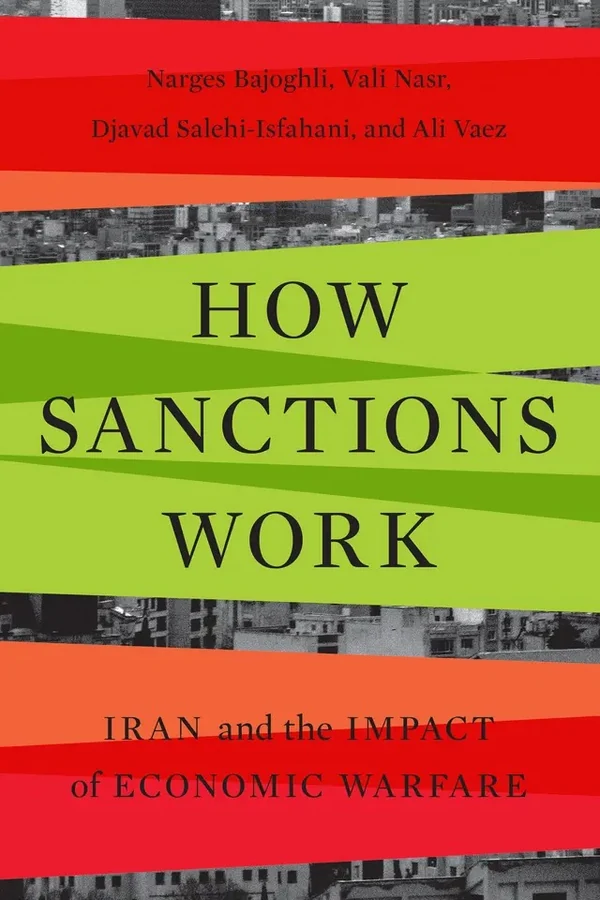
How Sanctions Work: Iran and the Impact of Economic Warfare
Narges Bajoghli, Vali Nasr, Djavad Salehi-Isfahani, and Ali Vaez
Stanford University Press, 2024
This timely, conceptually rich, and methodologically sound book draws on multiyear, long-form oral history interviews with many Iranians inside Iran, including activists, political actors, university professors and researchers, former members of the Revolutionary Guard who are now business owners. Additionally, multiyear discourse analysis of Persian-language media and social media, alongside survey data and official global and Iranian statistics are utilized throughout the book. Chapters examine the impact of sanctions on the internal society and politics of Iran, explore the economic history of sanctions alongside their escalation over the decades, and reveal the actual costs of sanctions, not only for Iran but also for the world more generally.
The authors skillfully bring an anthropologist, political scientist, economist, and policy analysts together to inform the audience on the largely understudied and unknown political efficacy of sanctions on Iran since the 1979 Iranian Revolution, as the country has become the most sanctioned country in the world (p. ix).
Growing evidence suggests that sanctions—favored foreign policy tool in Washington and the EU capitals—have become counterproductive and so difficult to lift irrespective of whether they are accomplishing their goals. Trump’s maximum pressure sanctions on Iran in 2018 caused several attacks on Saudi Arabia’ oil facilities by Iran in retaliations, contrary to what such pressures were supposed to accomplish. It has become abundantly clear that sanction “have strengthened the Islamic Republic, weakened and impoverished its population, and increased Iran’s military posture vis-à-vis the US and its allies in the region.” (p. xi). The longevity of the Islamic Republic is an obvious sign that a nation can indeed resist this so-called invisible war.
Several themes highlight the book’s main thrust that is built around calling into question the efficacy of sanctions as a foreign policy tool: (1) that ratcheting up sanctions without seeking a diplomatic offramp could risk war, (2) that the war with Iran would be costly to Washington and its Persian Gulf allies who had supported US policy, (3) that maximum pressure sanctions against Iran by the Trump administration were effective and devastating to Iran’s economy, yet they failed to force Iran to abandon its nuclear program. Instead, Iran returned to negotiations only after it had built a larger program, and (4) that the impact of sanctions on societies and civilians has become equated with an invisible war on “noncombatants,” raising serious moral questions (pp. 134–147).
Elsewhere, the unethical impacts of sanctions are underscored by John Mearsheimer who finds that US sanctions have killed 38 million people between 1971 and 2021. He has described these economic measures as a form of “mass homicide” deployed to inflict massive suffering on civilian populations.
The book goes on to examine how sanctions have affected Iran’s society, politics, and economy, but additionally, they consider the blowback costs of sanctions to the international community and regional as well as global powers such as Russia. In the case of Iran, increasing evidence points to the way the Iranian state has become more militaristic because of ongoing sanctions. The result has been that the state has become engulfed in further deepening of security paranoia and repressive methods. Sanctions have failed to compel Iran to compromise its foreign policy, but rather forced Tehran to innovate: “just not in ways that are amenable to the West” (p. 7). Sanctions against the Islamic Republic have brought on paradoxical results, strengthening hardliners while weakening reformists and moderates, thereby marginalizing those who advocate for a balanced foreign policy and détente with the West and the United States. This trend became obvious most notably after the US withdrawal from the Joint Comprehensive Plan of Action (JCPOA) under President Trump and the subsequent imposition of secondary sanctions, which weakened the middle class and drove its political disengagement from the political system. That may explain why hardline factions have gained increasing leverage over both the Iranian parliament (since 2019) and the executive branch (since 2021).
Trump’s exit from the nuclear deal and the resulting secondary sanctions amplified hardliner voices—echoing the Supreme Leader’s longstanding narrative of mistrust toward the West—to a degree that even after Masoud Pezeshkian’s administration took office, his authority over strategic foreign policy issues, including negotiations with the United States and the post-February 2026 management of the Strait of Hormuz, has been entirely stripped from the executive branch. This trend is unlikely to be corrected and reversible if the current pressures abound. The book argues that “sanctions have created an economy both resilient and resistant, one capable of—and ready to—shower missiles on US military bases or Ukraine’s civilian infrastructure.” (p. 7).
Sanctions have targeted the economic lifelines of Iranian society. Across the country, sanctions have adversely affected cost of living, plunging the country into poverty, creating black and gray markets from which the top strata of society have enormously benefited. Over eight million individuals have fallen from the middle class to the lower middle class. As a result, the ranks of the poor have swelled by more than four million (p.11). The maximum pressure since 2018, combined with the waves of COVID-19 pandemic, impacted Iran more than any other country in the Middle East (p. 14). The result has been entrenching anti-Americanism not only withing the ruling establishment in Iran but also among ordinary Iranians who did not express such sentiments before maximum pressure sanctions (p. 19).
Increasingly, the country’s politics was equally sanctioned as demonstrated by the lowest turnout in postrevolutionary Iranian history. In June 2021, less than 50 percent of the electorate cast ballots (p. 29). Maximum pressure and comprehensive US sanctions have resulted in political hardening and increased military control over political culture. Most critically, they have done so while suffocating the voices for engagement and change (p. 31). While sanctions have weakened the independent businesspeople who had more ties to the West, they have enriched certain Revolutionary Guard enterprises and almost exclusively regime loyalists (p. 51). These sanctions have made those tied to the Revolutionary Guard and Khamenei’s inner circles the owners of most of the wealth inside Iran (p. 52).
The JCPOA, widely known as the Iran Nuclear Deal, concluded in 2015 under the Obama administration, was an agreement between Iran and the P5+1 (China, France, Russia, the U.K., and the US, plus Germany) that was designed to place limits on Iran’s nuclear program in exchange for sanctions relief. Before seeing daylight, it was suspended with the election of Donald Trump (p. 67). A new wave of sanctions (2018-present) was imposed on Iran at a time that Iran was adhering closely to the nuclear deal. Following the Russian invasion of Ukraine and the Iranian support of the Russian war adventures there, by providing drones and missiles to the latter, the Biden administration started imposing more targeted sanctions on Iran (p. 71). The book’s argument that sanctions remain a preferable option to military confrontation, as their removal might provide a way to advance negotiations in a diplomatic process, is credible. It should be noted, however, that “Because the United States has placed all of its eggs in the sanctions basket, failure may appear to leave no other option for the US but war.” (p. 73)
The impacts of sanctions on Iran’s economy are carefully scrutinized in chapter four, which demonstrates two realities: (1) all economic indicators point to a sharp change from growth to stagnation or decline and (2) a decade of harsh economic sanctions has failed to instigate economic collapse or change the regime or its behavior (pp. 74–75). In the case of Iran, employment increased under sanctions, and it only fell once, in 2020, due to the disruption of the COVID pandemic (p. 103). The stability of employment under sanctions was due to several factors, including the fact that virtually half of all workers in Iran are self-employed, and that labor laws discourage employers from laying off workers, and most notably, those who lose their jobs often tend to move to the large informal economy (p. 103). Meanwhile, because of the government’s decision to allow the currency devaluation, traded goods regained their advantage. Between the two bouts of sanctions, Obama’s in 2011 and Trump’s in 2018, inflation erased a good part of the devaluations, causing the real exchange rate to fall by nearly 80 percent (pp. 108–109).
Most significantly, sanctions marginalized Iran’s middle class, who were once known as the driving force for the country’s democratic reform. In some cases, the protests were directed at the political elites’ social policies rather than policies that had triggered the sanctions. If sanctions aimed to create a politically moderate Iran, they certainly failed (p. 76). Yet the fact remains that sanctions were instrumental in ending Iran’s robust growth of prior decades (2002–11). The disruption in oil exports, investment, currency values, and the growth rate of the GDP made clear that sanctions dealt a serious blow to Iran’s economy (p. 82).
This chapter argues that no clear patterns can be discerned regarding the impacts of sanctions on foreign exchange, living standards, nutrition, wages, the middle class, social protection, and employment. While these factors cannot be examined with their connections with the oil boom and oil bust in a country that is heavily dependent upon oil revenues and exports, the fact remains that there is an upward trend in non-oil GDP that accounts for the resilience of the Iranian economy under sanctions (p. 109). For the restructuring of economy to unfold, the author of this chapter argues for four preconditions: (1) economic stability must be provided for producers, (2) producers must gain access to credit to finance their investments, (3) producers must have access to global markets to import new technologies and to produce new inputs, and (4) producers should have access to external markets (pp. 109–110). The present conditions contain no sign that restructuring is steady or even accelerating (p. 110). While there have been a multitude of protests, thus far they have not reached the level that would threaten the regime or force it to submit to US demands (p. 110).
Increasingly, the sanctions have thrown Iran into the arms of Russia and China, moving Iran from its traditional neutral position vis-à-vis the “West and East” toward aligning herself with Russia and China (p. 124). What is missing from this chapter is the risks of Iran’s so-called Eastern policy. Tehran’s uneven geopolitical foreign policy reorientation has raised several questions: Does this foreign policy reflect the interests of ordinary people and not just specific groups or factions? Will the reformists—mostly familiar with Western ideas, systems, and cultures—be willing to embrace and adapt themselves to this Eastward shift largely harbored by Iran’s security apparatus?
The book concludes by noting that the overreach of US sanctions on Iran and Russia, as well as constraining the EU’s trade with Iran, is likely to lead to dethroning the supremacy of the dollar. The extraterritorial nature of sanctions, the authors contend, has led to decoupling global economic relations and promoting self-reliance. This prediction, however, falls short of reality, as Russia and China have yet to successfully dethrone the US dollar. As most experts argue, while they have nearly eliminated the dollar in bilateral trade—conducting over nearly 99 percent of their transactions in rubles and yuan—the US dollar continues to be the dominant global currency by a landslide.
Given that this book was published in 2024, before the US and Israeli attacks on Iran in June 2025 and subsequently in late February 2026, its findings dovetail nicely with the aftermath of these recent attacks, both of which have further strengthened the durability of the Islamic Republic even as it has lost several key leaders. The fact that the Trump administration began this unprovoked war and futile attempt to overthrow the Iranian regime serve as a somber reminder that the US policymakers now badly need to take a hard look at their sanction policy. To reach an agreement on Iran’s nuclear program will require considerable geopolitical ingenuity, restraint, and diplomacy. War and further sanctions are hardly the solution. That said, while I concur with the book’s central thrust and themes, it is important to recognize that sanctions should not be seen as the primary variable in Iran’s internal political dynamics.
The systematic exclusion of liberal, secular nationalists, reformists, and moderate factions has been pursued by Iran’s ruling institutions since the very inception of the Iranian Revolution, irrespective of sanctions. The case in point: At the dawn of the revolution, the liberal government of Mehdi Bazargan was practically undermined by revolutionary factions, as it was accused of maintaining ties with the West. Subsequently, secular progressive and nationalist currents were removed from Iran’s power structure. That explains why and how the Khatami administration was gradually weakened, as was the Rouhani administration. The Pezeshkian administration, despite its ostensibly moderate appearance, is indeed directed by hardliners, with the initiative resting with powers and institutions outside his administration. Arguably, while sanctions have acted as a catalyst, the underlying variable continues to be the Islamic Republic’s power structures and foundational approach since the 1979 Revolution have systematically marginalized and excluded the reformists political currents. Furthermore, Iran’s continuing high inflation rates in the past four decades have been and are primarily a result of an economic structure that is rooted in deeply embedded corruption and mismanagement. These quibbles aside, the book makes an invaluable contribution to the existing literature on the impacts of sanctions on Iranian politics and its foreign policy orientations. I highly recommend this book as it bridges the gap between scholars and policymakers.
Related Content
 Editorial Note: Iran and the New Middle East? (©Background) GlobIS Review, Issue 6
 New Horizons in Studying Iran–US Relations (©Background)
 The Crown Center: Middle East Studies at Regional and Global Intersection (©Background)
 Crude Oil and the Mirage of Development (©Background)
 War as the Production of Space (©Background)
Comments are closed.