Editorial Note: Iran and the New Middle East? (©Background)
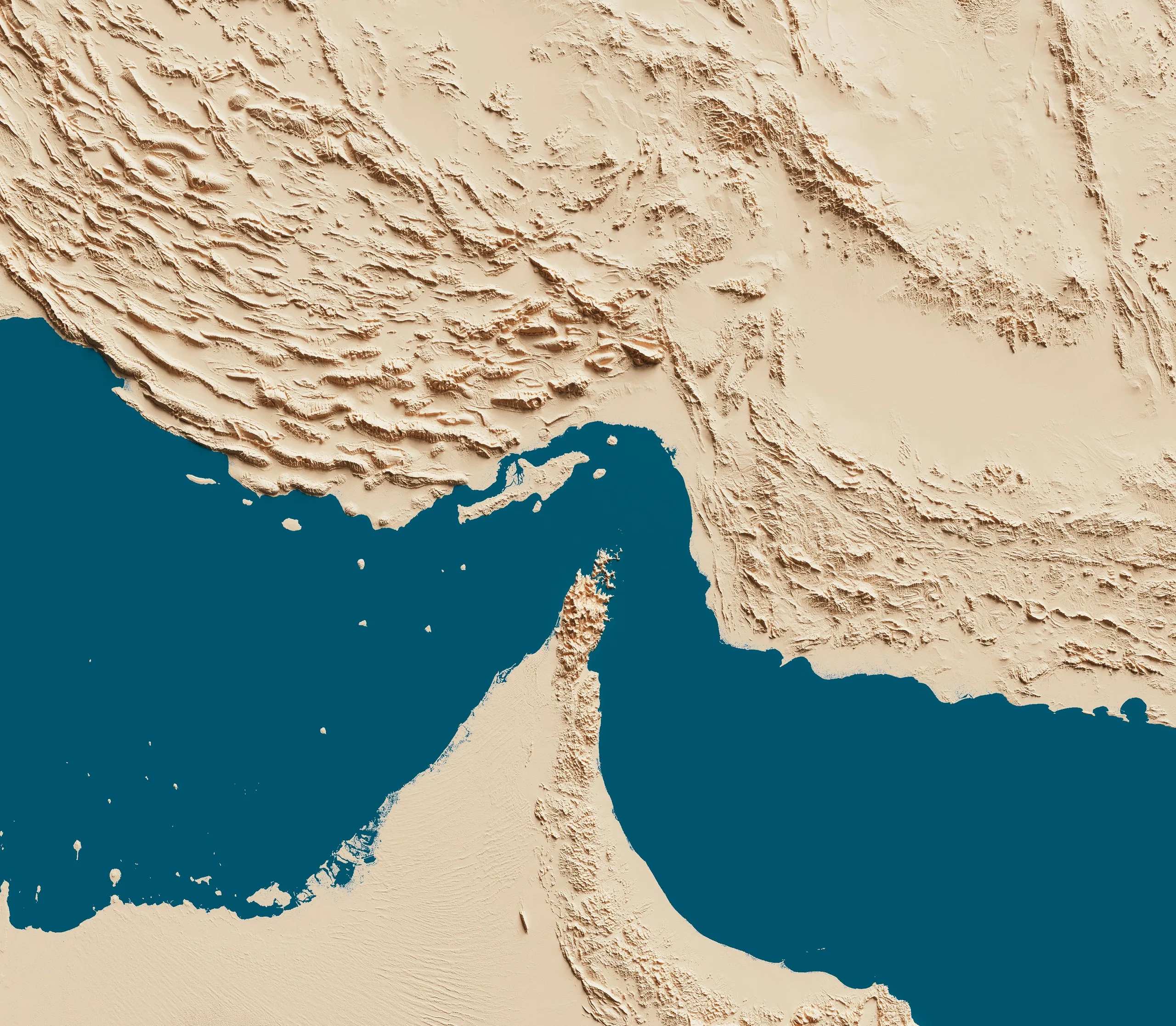
This issue of GlobIS Review aims to introduce some of the key themes and debates around the rise of a new regional order in the Middle East. This initiative would not have been possible without the support of the Crown Center for Middle East Studies at Brandeis University. Dr. Afshin Matin-Asgari served as the special issue advisor on Iran–US relations, and Dr. Arang Keshavarzian’s support was essential to this effort.
Since 9/11, the Middle East has undergone profound political, economic, and social transformations. Long-standing regimes in several Arab states have been displaced by foreign intervention, popular uprisings, and internal conflict, while the growing economic power of new regional actors has not necessarily translated into commensurate political influence. As the United States, the region’s dominant external power, becomes increasingly unable to sustain a functional regional order, regional powers seek to insulate themselves from instability through coalition-building, political and military intervention, cooperation with emerging global powers, notably China, and pressure on Washington to serve their strategic interests. Any new regional order that emerges from these efforts will therefore be shaped by intense competition among the region’s major powers, the deployment of their full military, economic, and diplomatic capabilities, and the role of the United States in containing—or intensifying—violence.
For some, the current war on Iran represents the culmination of these contested regional dynamics.
This issue of GlobIS Review engages with the literature on the “New Middle East” and scholarship examining Iran’s regional politics, treating these bodies of scholarship as a basis for rethinking the interconnectedness of transformations often examined separately in these two domains. As we will see, scholars in the field differ in their assessments of the forces shaping the Middle East and the extent of continuity and rupture within its prevailing order. Yet many have identified developments that challenge the existing order and point toward a possible “new regional order.” These studies have drawn greater attention within the political community to the Middle East as a region, its historical formation and political characteristics, and the structures and forms of agency shaping its transformation.
The idea of a “New Middle East” dates back to the early 1990s, when the end of the Cold War and the Oslo peace process were seen as opening the possibility of major transformation in the region’s political and security relations. Yet the failure of the peace process, the Gulf War, and increased US military presence contributed to the rise of transnational jihadi networks in the region and set the Middle East on a different trajectory. The September 11 attacks and the US response—the “War on Terror,” including the invasions of Afghanistan and Iraq—ushered in a decade of war and instability across the region— an era in which conceptions of regional order remained largely confined to a US-centered order sustained by military power.
The Arab uprisings of the early 2010s gave rise to a popular social imaginary of regional solidarity, centered on the possibility of replacing authoritarian regimes that had entrenched poverty and inequality through the dismantling of old welfare states through 1990s neoliberal economic policy initiatives. At the same time, the rapid economic growth of China and East Asia was reshaping the region’s external economic relations, redirecting oil and non-oil trade, investment, and infrastructure development toward expanding networks across Asia and Africa.
The books and other materials under review in this issue primarily engage with five major debates about the ME regional order. The first debate concerns the Middle East and global powers, particularly US hegemony in the region. In addition to works examining the history of Iran–US relations (Matin-Asgari, 2026; Ghamari, 2026; Kashani-Sabet, 2023; Ghazvinian, 2021), this debate encompasses studies of the impact of economic sanctions on Iran (Bajoghli et al., 2022); the effects of security threats and war on the formation of a security-oriented state in Iran (Nasr, 2025); the consequences of the US-led invasion of Iraq and the failure to establish an integrated state (Clark, Lucasik, and Oushakli, 2023); the emergence of a multipolar regional order (Lynch, 2021); and the historical entanglement of war and violence with state formation in the ME in context of the colonial legacy (Robson, 2020). The second debate centers on the Arab uprisings of 2011–13 and their implications for the possibility of transforming the regional order from below. It shifts attention from interstate power relations to the capacity of popular mobilization, collective action, and transnational political imaginaries to challenge entrenched authoritarian regimes and reshape regional politics (Lynch, Schwedler, and Yom, 2025; Andrews and Kinn, 2025; Bayat and Herrera, 2021; Gelvin, 2021).
The third debate examines the rise of Arab states of the Persian Gulf as centers of capital accumulation and geoeconomic power, driven by their growing influence in global financial markets, inter-Arab state financing, and participation in China’s development projects. It explores how Gulf competition is increasingly shaped by geoeconomic interests and extends beyond the region (Hanieh, 2018; Gelvin, 2021; Habibi, 2025; Batmanghelidj et al., 2026). The fourth debate examines how rivalries among competing ideological and political blocs shape the existing and future regional order. Some scholars trace these rivalries to ideological, religious, and ethnic divisions and the historical formation of dominant state identities (Ghahramanpour, 2015; Ahmadi, 2024; Akbari Dizgah, 2022). Others examine how these rivalries translate into political and military pacts and alliances, including the Abraham Accords, the “Axis of Resistance,” and the Mecca Pact (Fakhro, 2025; Azizi, 2026; Batmanghelidj et al., 2026). Finally, the fifth debate addresses the regional repercussions of the Israeli–Palestinian war and the ways in which its expansion is transforming the Middle East, marking a departure from four decades of largely covert hostilities between Iran and the US. (Nasr, 2025; “Iran War” roundtables, Crown Center, 2026).
This issue includes two interviews with scholars specializing in the region, reviews of seven books recently published in English, translations of five analytical pieces from the Crown Center for Middle East Studies, and reviews of three books published in Iran, including two on international relations and a novel recounting the journey to Beirut of a young writer supportive of the Islamic Republic. Eight additional books are featured in the short reviews section.
In a conversation on the history of Middle East studies and recent regional developments, Arang Keshavarzian speaks with Naghmeh Sohrabi and Ramyar Rossoukh, directors at the Crown Center for Middle East Studies. Drawing on the Center’s two decades of experience, they discuss the importance of regional and interdisciplinary approaches to understanding the Middle East as an interconnected space, the political challenges of conducting field research in the region, the limited availability of new teaching positions, and constraints on comparative research. They argue that the Middle East has been continuously changing and that claims about the emergence of a “new order” require further research and more evidence.
The Middle East and Global Powers
The opening interview in this issue is with Afshin Matin-Asgari, author of Axis of Empire: A History of Iran–U.S. Relations (2026) and an adviser to this issue on Iran–US relations. We discuss the significance of Iran–US relations in shaping the regional order, as well as his views on the Islamic Republic’s anti-imperialism and the prospects for normalizing relations with the United States and ending hostilities with Israel. The issue also features short reviews of several recent books on Iran–US relations, including John Ghazvinian’s America and Iran: A History, 1720 to the Present (2021), Firoozeh Kashani-Sabet’s Heroes to Hostages: America and Iran (2023), Behrooz Ghamari’s The Long War against Iran: Recent Events, Old Questions (2026), and Nader Entessar and Kaveh L. Afrasiabi’s Trump and Iran (2019), which examines the Trump administration’s withdrawal from the nuclear agreement, the reimposition of sanctions, and its regime-change policy. However, most reviews in this section engage with international relations literature examining the consequences of US interventions in the region, including sanctions, military intervention, and involvement in regional wars. How Sanctions Work: Iran and the Impact of Economic Warfare (2024), by Narges Bajoghli et al., suggests that sanctions functioned as an invisible war against civilians and, contrary to their intended purpose, have encouraged militarization, strengthened Iran’s ties with Russia and China, and marginalized advocates of engagement with the West. Mahmood Monshipouri finds the book’s analysis of sanctions valid, and its anticipation of sanctions’ shift into warfare consistent with subsequent developments.
Vali Nasr’s Iran’s Grand Strategy: A Political History (2025) traces the Islamic Republic’s formation back to the revolutionary period, emphasizing how insecurity stemming from the United States and the Iran–Iraq War shaped its security-oriented state. Nasr argues that Iran’s foreign policy follows a logic of survival and that, despite factional competition over the relative priority of security and economic development, regime security has remained paramount. In his review, Esmail Izadi argues that Nasr’s account of government rationality under the Islamic Republic is state-centred and persuasive from this perspective, but it underestimates the role of its ideology in foreign policy and sidelines tensions already emerging from the imbalance between survival and inclusive development in the country.
A Thousand Saddams: The Fate of Iraq’s Democracy (2023), a conversation with Killian Clarke, Candace Lukasik, and Kerem Uşşaklı, examines the decentralization of coercive power in Iraq, where parliament is dominated by parties closely linked to militias. It suggests that the United States failed to build a state capable of securing broad political consensus and curbing authoritarianism. The current government has also failed to match Saddam’s regime in providing basic services and infrastructure.
Nasr argues that Iran’s foreign policy follows a logic of survival and that, despite factional competition over the relative priority of security and economic development, regime security has remained paramount.
Gelvin’s The Contemporary Middle East in an Age of Upheavals (2021) links the expansion of regional states’ military and security capacities to heightened insecurity and perceptions of existential threat following the US invasions of Iraq and Afghanistan, arguing that regional actors increasingly came to wage wars that during the Cold War had often been driven by global powers.
Lara Robson’s The Politics of Mass Violence in the Middle East (2020) traces the historical entanglement of war and violence with state-building in the region through three stages: the colonial use of exceptional violence to sectarianize and divide the Ottoman Empire; postcolonial states’ adoption of violent colonial practices to claim territory and eliminate rivals; and twentieth-century foreign interventions aimed at securing access to oil and containing communism, or justified by efforts to prevent nuclear proliferation and provide humanitarian assistance.
The Arab Uprisings as Social Transformation
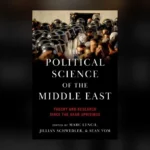
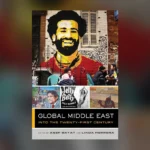
The Political Science of the Middle East: Theory and Research Since the Arab Uprisings (2025), edited by Lynch, Schwedler, and Yom, examines scholarship on Arab politics produced in the aftermath of the 2011 uprisings. In her review, Farideh Shahriari notes that the contributors’ findings challenge the myth of the absence of pro-democracy forces in the Middle East. Yet they caution against generalizing from their findings given the uneven trajectories of democratic change across societies and states, and consider talk of a “new Middle East” premature in the absence of a coherent and durable regional order. The Global Middle East (2021), edited by Asef Bayat and Linda Herrera, examines how transnational exchanges and global interconnectedness shape the region’s political, cultural, economic, and social formations. It traces these connections through music, football, food, globalized fashion such as the keffiyeh, solidarity with regional protest movements and the circulation of their images, as well as migrant workers and diasporic communities, arguing that these exchanges transform societies on both sides. The introduction has been summarized and edited under the editors’ supervision for republication in this issue.
Nader Andrawos and Daniel Neap’s (2025) conversation with the Crown Center examines recent political developments in Syria and its gradual emergence from isolation under Ahmed al-Sharaa, the first Syrian leader to address the General Assembly since 1967. Syria’s Uncertain Transition argues that Sharaa’s government must engage with civil society, while the transition remains uncertain partly because of the risk of ethnic and sectarian fragmentation, despite the integrative aspirations of civil-society networks and grassroots groups that emerged during the collapse of the Assad state. Gelvin (2021) likewise identifies the Arab uprisings as a major force in transforming the Middle East, with contributions to his volume tracing instances of passive revolution in some monarchies, welfare reforms in others, and the incorporation of Islamist movements into parliaments, alongside the growing moderation of some movements and the repression of others.
The Emerging Geoeconomics of the Persian Gulf
The oil economy has long been viewed as the foundation of the region’s economic order, a driver of colonialism and foreign intervention, and a pillar of authoritarian rule. Against this background, debates over changing patterns of economic development in the Gulf states—which have emerged over the past three decades as major centers of capital and wealth accumulation—constitute another line of argument in scholarship on transformations in the Middle Eastern order. Rohan Advani’s review of Money, Markets, and Monarchies, which details the inexorable links between regional economic liberalization, the expansion of Gulf capital and the entrenchment of monarchical power across the region, was translated and published in our special issue on Persian Gulf Studies. In this book, Hanieh traces the relocation of the Middle East’s financial center from Lebanon to the Gulf and the transformation of the GCC financial markets into a vital space for Middle Eastern capitalism. A substantial share of foreign investment in the financial sectors of major Arab countries is linked to GCC capital. This issue reviews Laleh Khalili’s Sinews of War and Trade (2020), which examines the intersection of oil, war, and maritime trade in the development of capitalism in the Arabian Peninsula. Recently translated into Persian, the book shows how regional capitalism has been fueled by wars and “war spoils,” from the Suez Crisis to the Iraq War, while reshaping the region’s geography through maritime infrastructure, trade routes, and new ports and urban centers. In his review, Aidin Torkameh argues that the book contributes to understanding the development of capitalism in the region and how it differs from factory-based industrialization: the region’s oil and construction giants have emerged largely through the production of space itself. On the other hand, Nader Habibi (2025) and Kahalzadeh (2026) emphasize China’s role in providing these states with a new economic landscape and the potential to shift away from geopolitical conflicts. Habibi argues that China’s emergence as a trading partner and investor has given governments facing domestic pressure to avoid geopolitical competition an opportunity to pursue economic reform. Kahalzadeh extends this argument to Turkey, arguing that China has provided Saudi Arabia and Turkey— both of which had encountered setbacks in their interventionist policies toward their neighbors—with the tools and confidence to pursue de-escalation and move toward investment in infrastructure and regional cooperation.
Competing Political and Ideological Blocs
The emergence of a multipolar order in the Middle East is driven by different factors; as noted above, this includes the role of global powers in heightening regional insecurity, the impact of the Arab Spring on both political reform and instability, and economic transformations that have shifted the region’s centers of power. However, current scholarship has also examined the political and ideological dimensions of this multipolar system, and its inner conflicts, the weakness of mechanisms for resolving conflicts without resorting to force, and patterns of coalition-building for proxy wars.
Raihan Ismail (2023), in Saudi Salafi Clerics under MBS: Reform and Survival, examines the simultaneous decline of political Islam and conservative Islam in the country. She notes that enforcing Islamic norms expanded during the 1970s, followed by two decades of growing Salafism after the Iran Revolution. However, due to international scrutiny of Salafism and its undeniable association with the rise of ISIS in the post-September era, the Saudi leadership distanced itself from the movement. Today, Saudi Arabia is seeking to construct a form of nationalism alongside a project of economic regionalism.
Among recent international relations scholarship on Iran, studies that explore the role of ideology and political identity in shaping the region’s growing conflicts are popular. One is Political Currents in the Middle East and Iran’s National Security, a university text by Hamid Ahmadi that examines Iran’s security challenges through six ideological and identity-based currents in the region: Pan-Arabism, Pan-Turkism, Jewish nationalism and Zionism, Marxism, Islamism, and ethnic nationalism. He argues that Iran’s shift toward a “transnational idealism” following the US invasion of Iraq, and its support for Islamic movements in the region, intensified the conflicts with the Arab world and existing sanctions. In her review, Samer Saremi appreciates the book’s framing of Iran’s security challenges, while noting that it gives less attention to divisions within ideological blocs and political alliances that cross identity boundaries.
In Identity and Foreign Policy in Iran and the Middle East, Rahman Ghahramanpour examines four regional states through the lens of their dominant state identities and explores how these identities shape their definitions of national interests and foreign policy. According to him, the Islamic Republic’s dominant identity is shaped by political Islam, revolutionary ideology, and Shi’i ideology, just as Kemalism/post-Kemalism, Pan-Arabism, and Zionism emerged from different combinations of ideological elements at particular historical junctures. These identities may adapt to changing circumstances or become increasingly rigid, potentially obscuring underlying national interests—a risk he identifies in both Iran and Israel. In his review, Nima Shojaei appreciates the book’s grounding in historical sociology but notes its limited attention to the role of foreign intervention and economic interests in rendering these ideologies more rigid.
Beyrut (2022) by Ebrahim Akbari Dizgah is an account of the waning of transnational ideological solidarity as experienced by a young Islamic intellectual from Iran. Blending the forms of a novel, travelogue, and documentary narrative, the book follows his journey to Beirut to make a documentary about Imam Musa al-Sadr. A popular read in Tehran, the book portrays Beirut’s Shi’i district of Dahiyeh as increasingly marked by sectarian divisions, contrasting this with al-Sadr’s vision of Sunni-Shi’i-Christian unity. It urges readers to confront today’s “Beyrut” rather than romanticize solidarity with Lebanon’s Shi’a. In her review, Shima Vezvaei interprets the fading of transnational solidarities, the author’s enthusiastic return to Iran, and his turn toward nationalism as signs of a new generation of Muslim intellectuals coming to terms with the end of the Islamic solidarity era.
Another group of studies in this field examines existing military-security pacts, institutions, and agreements rather than states’ ideological orientations. Elham Fakhro (2025) examines the Abraham Accords and their success in establishing formal relations between Arab states and Israel—an agreement whose very name was intended to evoke reconciliation among the three Abrahamic faiths. She argues that Washington’s growing focus on expanding normalization with Israel came at the expense of attention to the Israeli-Palestinian conflict, reinforcing conditions that contributed to regional instability. We introduced her book in the short reviews section of this issue.
Blending the forms of a novel, travelogue, and documentary narrative, the book follows his journey to Beirut to make a documentary about Imam Musa al-Sadr.
Hamidreza Azizi (2026), in The Axis of Resistance: Iran, Israel, and the Struggle for the Middle East, reviewed in this issue by Marzieh Kouhi Esfahani, examines the so-called “Axis of Resistance” from Iran’s perspective, defining it as an umbrella for resisting a much stronger adversary by distributing “vulnerability.” He traces its development through four stages: the revolutionary period and the idea of exporting the revolution; the post-2003 creation of coordinated networks for Iran’s preemptive defense; its expansion during the war against ISIS and the instability following the Arab uprisings; and its post-Soleimani transformation into a more horizontal structure with considerable autonomy. He argues that the Axis was intended to compensate for Iran’s “strategic loneliness,” but that its strength was weakened by the Gaza war, limiting its effectiveness as a deterrent.
Arash Reisinezhad’s The Shah of Iran, the Iraqi Kurds, and the Lebanese Shia. (2019), reviewed in this issue by Hamidreza Yousefi, traces Iran’s use of non-state actors for regional alliance-building during the Pahlavi era and the Cold War. He shows how, fearing the rise of Pan-Arabism following the overthrow of Iraq’s monarchy in 1958, the Shah pursued a policy of cultivating Lebanon’s Shi’a and supporting Iraqi Kurds. This history suggests that alliances with non-state actors stem less from recent regional multipolarity or Iran’s “strategic loneliness” than from the absence of regional agreements prohibiting interference in internal affairs. Sunni-Shi’i polarization and competing Saudi- and Turkey-led alignments offer further examples of alliance-building through non-state actors in Iraq, Yemen, and Syria.
The Question of Palestine and the Israel–Iran Conflict
The wars ignited by the October 7 Hamas attack demonstrated how the Israeli-Palestinian conflict could expand beyond immediate neighbours, reigniting old hostilities between Israel and Iran—contained and managed for more than four decades—and drawing fuel from tensions in Iran–US relations. Israel’s response to the Hamas attack has been devastating and, according to a UN report (Report 227), has resulted in more than 73,000 deaths by June 2026. Accordingly, some scholars examining the regional order in the Middle East identify the Israeli-Palestinian conflict as a fifth factor shaping the solidarities and conflicts that structure the region, particularly when the conflict extends beyond its conventional boundaries.
Vali Nasr (2025) views the expansion of the Gaza war to Iran as the inevitable consequence of Iran’s collapsed deterrence. He argues that, as Israel gained the upper hand over resistance in Gaza, Hezbollah and Iran’s presence in Syria could no longer serve as effective deterrents against an Israeli attack. Israeli strikes on Hezbollah severely weakened its capacity to fight in Syria, contributing to the collapse of the Assad regime and leaving Israel prepared to strike Iran directly. In June 2025, Israel launched a twelve-day war against Iran, followed by US strikes on three Iranian nuclear sites. A new round of US-Israeli attacks began in February 2026, targeting Iran’s leadership and missile and nuclear capabilities for 40 days. The Islamic Republic survived the attack, despite expectations of regime collapse, and, in response to US attacks, struck military bases and infrastructure used by the United States in the southern Persian Gulf. The closure of the Strait of Hormuz and the disruption of oil and other trade flows further expanded the war’s regional and global repercussions. A growing body of literature examines the drivers of these attacks and their implications for Iran and the regional order. This issue features translations of three Crown Center roundtables on the “Iran War.”
In the first roundtable, Mehdi Kahalzadeh, Naghmeh Sohrabi, and Esfandiar Batmanghelidj examine the war’s implications for the Iranian state, society, and economy (Kahalzadeh et al., 2026). To explain the origins of the attacks, they point to several factors, including the Islamic Republic’s declining political legitimacy, perceptions of its imminent collapse, and the Trump administration’s insufficient knowledge of political dynamics in Iran and the wider Middle East. They also discuss how the costs of continuing the war would be transferred onto Iranian society, as it has exacerbated economic hardship and deepening poverty to this day. Finally, they argue that sustainable peace and stability will require lifting sanctions to enable meaningful economic reconstruction and help Iran move beyond a prolonged “condition of survival.” Equally important for peace is fostering hope for the future in a society that feels trapped in profound uncertainty about the country’s future
The second roundtable brings together Ben Joseph-Hirsch, Shai Feldman, and Gary Samore (Joseph-Hirsch et al., 2026) to examine the war from US and Israeli perspectives. They discuss how the US and Israel entered the war with different objectives and highlight a growing divergence in US and Israeli public support for the war over Iran’s nuclear program. They also examine the disagreements that emerged as the conflict extended beyond the quick resolution the United States sought and discuss how the war has affected domestic politics differently in the two contexts.
The third roundtable, featuring Nader Habibi, Arang Keshavarzian, and Sanam Vakil (Habibi et al., 2026), examines the war’s consequences from the perspective of the Gulf states. They discuss the Gulf countries’ efforts to manage regional tensions, their growing recognition of the region as a shared, interconnected geography, and their concerns about the vulnerability of the Gulf’s development trajectory. From this perspective, the region’s future depends on initiatives to establish multilateral conventions and institutions that can regulate and protect a shared living environment and ensure disputes are resolved through negotiation rather than war.
Conclusion
The works reviewed in this issue examine the erosion of the US-dominated unipolar world of the 1990s in the Middle East over the past three decades, and the collapse of regimes that maintained power for decades by aligning with one of the two global power blocs. While some of the works consider the concept of a “New Middle East” timely and appropriate for describing the order emerging from this collapse, others regard it as premature to say that either the old order has broken-down or a new one is forming. Instead we may be in the midst of a protracted interregnum. These works share, however, the view that current transformations do not signal either the demise of US imperial power in the region or a revolution in social relations against its capitalist order. Rather, they point to the growing will, capacity, and opportunities of the region’s major states to shape its internal relations.
Does this transformation have a democratic and emancipatory character? It does so only insofar as it prevents future military attacks and inter-state wars. Yet we need to recognize that popular pressure also contributed to the collapse of the old order and shaped states’ growing determination to assert a greater role in regional affairs. This transformation reflects not only military competition, geopolitical rivalry, and responses to external threats, including the rise of radical Islamism, but also the legacy of the Arab uprisings and continuing demands from below for socio-economic reforms that benefit wider society. The rise of Saudi Arabia as major regional power has also been accompanied by top-down cultural reforms that mark a shift from its historical role as a source of radical Islamist influence across the region.
The war with Iran has brought to a critical turning point the ideological and religious divisions that have long masked regional power struggles and the alliances through which regional powers have waged proxy wars. Regional powers now stand at a crossroads between redirecting competition toward economic development and cooperation, and pursuing military buildup at the risk of recurrent and potentially interminable wars. The prospects for a shift toward economic competition, however, remain constrained by US support for Israel, whose regional strategy has continued to generate successive rounds of conflict.
References
All sources cited in this commentary, except for the following, refer to reviews published in this issue.
UNRWA, 2026. Situation Report #227 on the Humanitarian Crisis in the Gaza Strip and the Occupied West Bank, including East Jerusalem. 25 June 2026.
Related Content
 GlobIS Review, Issue 6
 New Horizons in Studying Iran–US Relations (©Background)
 The Crown Center: Middle East Studies at Regional and Global Intersection (©Background)
 When Categories Cease to Explain: Political Science and the Middle East after the Arab Uprisings (©Background)
 Global Middle East (©Background)
 A Review of the Persian Gulf Studies Quarterly (©Background)
Comments are closed.