Global Middle East (©Background)
Visual concept and digital composition by Sana Zand
ISSN 2818-9434
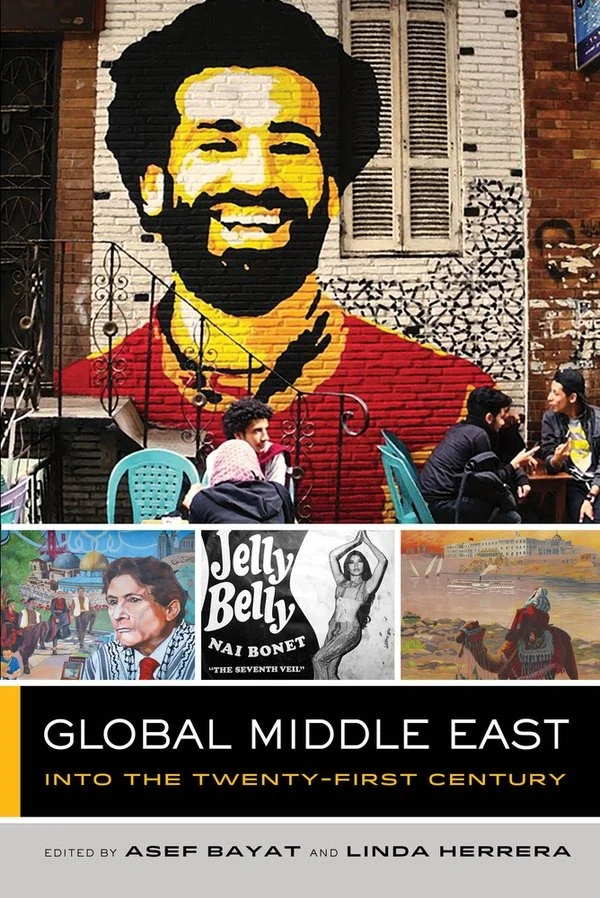
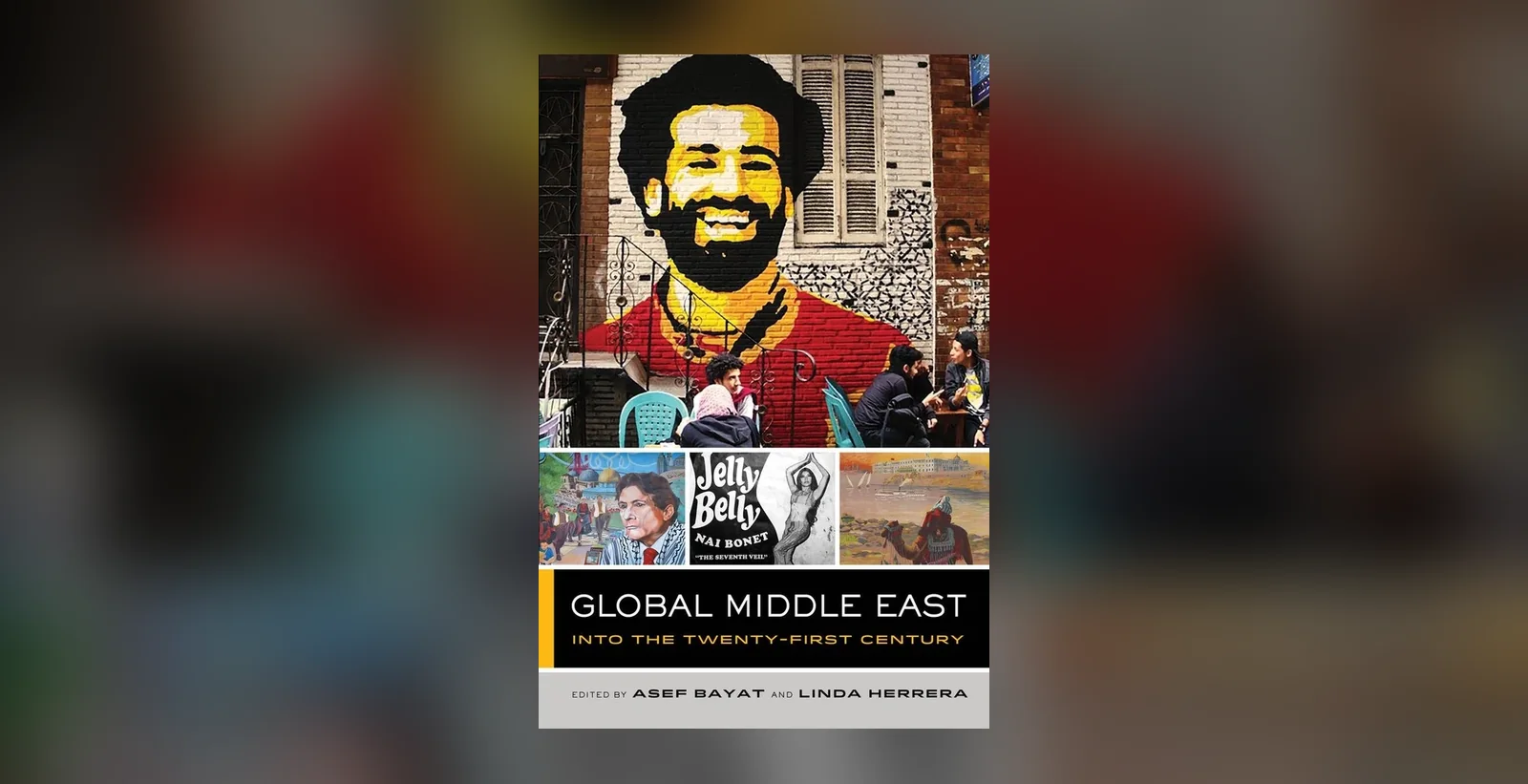
Global Middle East: Into the Twenty-First Century
Asef Bayat and Linda Herrera (eds.)
University of California Press, 2021
The book Global Middle East: Into the Twenty-first Century, edited by Asef Bayat and Linda Herrera, is an elegant exploration of the globality of the Middle East. Organized into seven sections and twenty-seven chapter, the volume examines the region’s global entanglements through social, economic, artistic, scientific, cultural, intellectual, and religious perspectives, with each section written by a leading expert in the field. To introduce this important work, we present an excerpt from its introduction with the permission of the editors.
Rarely do localities, countries, and regions develop over centuries and millennia in isolation; rather, they develop in complex interaction with others. The societies of the Middle East and North Africa (MENA), a region also referred to as North Africa and West Asia (NAWA), are not an exception. Their economic, political, cultural, scientific, intellectual, and artistic formations have come about from a complex set of flows, innovations, interactions, and exchanges with those outside and within the region. Ever since the idea of “global” or “worldliness” has been part of people’s consciousness, the region has been immensely influenced by various global forces. It has also profoundly impacted developments in other parts of the world, including what is generally called the “West.”
Yet the Middle East has long been viewed from an “exceptionalist” lens in much of the Western press, cinema, television, literature, and scholarship. This exceptionalism depicts peoples and societies as being resilient to change, entrapped by their own history, culture, and religion, and prone to tribalism and nativism. In such a view, culture and religion rarely change, and contemporary conflicts are often attributed to stubborn religious and sectarian rivalries dating back centuries, if not millennia. News media, for instance, are replete with explanations of the Middle East as a region of continuous war, sectarian bloodshed, the cradle of extremism, oppression of women, and religious conflicts, as if these are the result of an innate, inward-looking, and change-resistant culture. Only rarely do analysts take into consideration how the role of geopolitics, multinational entanglements, arms sales (which are among the highest in the world), military interventions, climate change, technological advances, social media networks, high rates of internal and external migrations (the list goes on) influence, transform, and alter societies, from all directions.
For a short period during the Arab uprisings of late 2010 through 2013, a break to the mainstream narrative occurred. Media from much of North America and Europe celebrated the protestors as global models of pro-democracy, nonviolent warriors from progressive youth movements.1 However, the so-called Arab Spring soon turned into what countless analysts prosaically dubbed the “Arab Winter,” and a return to the old paradigms of regional stagnation and sectarianism ensued. This resorting to stereotypes to understand the region while sidelining crucial developments in geopolitics, markets, technology, social policies, climate change, grassroots movements, and other dynamics is partially rooted in what Edward Said famously termed “Orientalism.”
Today a powerful neo-Orientalist approach depicts the region as largely homogenous, closed, parochial, and resistant to change. Imagined in this fashion, the Middle East has little of value to offer to the world and is responsible for its own troubles. This binary of the (Middle) East versus the West has come to occupy a central place in the well-known “clash of civilizations” theory advanced by political scientist Samuel Huntington in 1993. Huntington viewed an essential opposition between the Western and Islamic civilizations. The idea of this clash has considerably shaped perceptions in the United States about Islam and the Muslim-majority Middle East, in the media and foreign policy circles as well as among different publics.
Few would deny that in past decades countries in the region have suffered from debilitating wars, stifling political repression, new forms of patriarchy, growing inequality, and more entrenched religious extremism and radicalism. But are these features rooted in local culture and an outgrowth of longheld traditions? Take, for instance, Islamic radicalism, jihadi terrorism, or the phenomenon of the so-called Islamic State (ISIS). If these were inherent landscapes of local cultures and traditions, why did they emerge largely after the 1970s and seldom appeared before that time? How do we explain the fact that only “very few radicals have a past of long-standing piety, and most of them are religiously illiterate,” as Olivier Roy asserts (chapter 21) in this book?
The truth is that jihadi terrorism did not naturally arise from certain values intrinsic to local culture. Rather, it was imported and spread by thousands of youths from diverse national, class, and educational backgrounds who joined the Mujahedin in Afghanistan during the Cold War. The Mujahedin, with the support of the United States, worked to expel the Soviet invaders. At the time, al-Qaeda was under the leadership of Osama Bin Laden, the son of a construction magnate with close ties to the Saudi royal family, who advanced the cause of global terrorism in the name of Islam. He turned on his former US ally and is widely reputed to have masterminded the September 11, 2001, terrorist attacks. As Roy argues, violent radicalism of militant Islamists or jihadi terrorists has little in essence to do with the idea of “jihad” as understood in the legal Islamic tradition.
Another example can be found in the ongoing conflict between Palestinians and successive Israeli governments. Although some analysts try to shape the narrative by claiming Israel’s “biblical right” to the land of Palestine, or reduce the conflict to “age-old” hostilities between Islam and Judaism, the conflict is in fact rooted in far more recent history, particularly since World War I. This history includes British support for the establishment of a “national home for the Jewish people” with the Balfour Declaration of 1917, European anti-Semitism that culminated in the horrors of the Holocaust, the development of strong strategic alliances between the United States and Israel, and the capitulation of certain authoritarian Arab states to the status quo. Evangelical Christians in the United States point to end-time prophecies in their support of the modern state of Israel.
Each chapter in this edited volume is a testimony to the global interlinkages of the Middle East in the political, economic, cultural, intellectual, and artistic domains. The authors narrate how these domains have been shaped by interconnections to transnational forces, peoples, and geographies. But this globality has been complex, taking different expressions and involving different layers, scales, and directions. Sometimes it is expressed in how certain events or interests from outside affect a particular society; other times it is manifested in how persons, products, or cultural registers circulate, travel through national boundaries to be taken on and shared by others.
Geopolitical Effects
Although we do not hold the Orientalist view of cultural exceptionalism, there does exist a kind of “geopolitical exceptionalism” in the region, forged by the trilogy of geography, oil, and Israel—elements that have historically heightened imperial dominance and intraregional rivalry. In the aftermath of World War I, Ottoman provinces were carved into zones of British and French influence in the infamous Sykes-Picot/Asia Minor Agreement of 1916. These artificial borders divided peoples and historic communities, splitting contiguous groups like the Kurds and Druze. In the postcolonial period of the 1950s through the 1970s, the forced creation of distinct nation-states planted the seeds of territorial claims and conflicts, instigating wars between neighboring countries.
Thirst for raw materials and control over trade routes brought the lives of the colonized people into global circuits of trade and transportation, production and profit. In the late nineteenth century, for instance, 80 percent to 90 percent of Egyptian exports, mainly cotton, went to British and European textile mills, not only because the American Civil War (1861–65) cut down the US cotton production in the world market, but especially because British colonists wanted Egypt to export its raw material rather than produce its own textiles. Today, even though it is theoretically free from colonial control, Egyptian cotton is entangled in a global network that connects a cotton grower in the Nile Delta to a seaport in Alexandria, a cotton exchange in Liverpool, a factory in Lancashire, a retailer in America, and courtrooms in various major capitals of the world.
To add salt to the wound, the highly desirable commodity of Egyptian cotton used to make sheets and shirts may not even originate in Egypt because, as Ahmed Shokr discusses (chapter 15), the label “Egyptian cotton” in legal and commercial parlance is not a national marker but a quality brand.
A number of countries in the MENA region— Iran, Iraq, Palestine, Sudan, and Syria to name but a few—already suffer from inadequate water and energy, and in some areas the situation is dire. As Jeannie Sowers relates (chapter 13), key human factors contributing to drought and other forms of environmental degradation include wars, civil strife, occupation, and mismanagement. Egypt shares the river Nile with Sudan, Ethiopia, and Uganda, and conflict between these countries can very quickly trigger crisis in the supply of water, energy, and agricultural products—elements that are so deeply interconnected.
The discovery of oil in the Arabian Peninsula transformed geopolitics and transnational trade, triggering massive transregional migration flows as well as economic and social developments. Since the 1970s, Iran and the Gulf Arab countries gained immense revenues from oil and in turn experienced remarkable economic growth, the rise of a middle class, infrastructural development, social changes, and quests for democracy. At the same time, oil enabled autocratic and authoritarian governments to rule as “rentier states.” They dispensed welfare to their citizens and attempted to appease and essentially buy off dissenting groups. More significantly, as oil became an energy source driving global economic growth, foreign powers and their corporations established influence in the region and supported autocratic regimes in exchange for direct access to oil and economic and political favors. As Timothy Mitchell shows (chapter 14), the largest oil-importing countries encouraged massive arms sales to recycle the money they would pay for importing oil.
In other words, the absence of democratic rule in the region is not simply an outcome of religion or age-old traditions or cultural practices. Rather, this absence is largely linked to the region’s political economy and powerful enablers of repression and autocracy. People in the region have responded to these challenges partly by deploying the language of “human rights” adopted from United Nations (UN) charters, conventions, and international NGOs. Yet as Lori Allen illustrates (chapter 23), “human rights” have been torn between the imperial desire to use them as a tool of geopolitical dominance (e.g., invading foreign countries in the name of “bringing democracy,” “enforcing human rights,” and “protecting women and children”) and the indigenous urge to invoke rights as an empowering language for social struggle.
Circulating Beliefs, Arts, and Foods
If global forces and processes—such as colonialism, oil markets, or arms sales—have deeply influenced the politics and economies of individual countries in the Middle East, ideas and cultural products from the region have equally shaped the social and cultural landscapes outside the region.
The remarkable global circulation of belief systems, technologies, music, and foods that originated in the Middle East profoundly transformed the course of human history. The very idea of monotheism as a state religion likely originated in ancient Egypt during the reign of Pharaoh Akhenaten (1353–1336 BCE). The idea of a single universal deity has been the cornerstone of the three main Abrahamic religions—Judaism, Christianity, and Islam—all of which were born in what we now refer to as the Middle East. It is remarkable to note that in the twenty-first century, more than half the world’s population adheres to an Abrahamic religion, a topic pondered by Ebrahim Moosa (chapter 2). Moosa shows how the idea of prophecy in these monotheistic religions underlined the impulse to create a worldly political order in which God occupied a central place, beginning with the notion of “heavenly king” and continuing with today’s religious fundamentalisms. The monotheistic God has had enormous global staying power and remains as strong a phenomenon as ever despite relentless challenges from science and secular sensibilities.
As notions of prophecy and worship traveled with merchant ships, pilgrim caravans, and migrants, so too did food and recipes. Today we take for granted certain food or drinks but have little knowledge of their origins. Sami Zubaida (chapter 9) lays out the historical circulation and art of food. As empires spread, so too did their quest for culinary distinction. The diffusion of small dishes or appetizers known collectively as “mezze” (originally a Persian word) into global diets has transformed the traditional European meal pattern from full course meal into largely shared “small plates.” Nowadays, in what Zubaida calls a global “foodie milieu” in the Western foodscape, such Middle Eastern foods as kebab, hummus, falafel, baklava, or mezze have entered common food vocabularies.
Like food, music holds an extraordinary capacity to spread and merge cultures. With an intangible nature, semantic ambiguity, and no impassible social boundaries, music remains a most “globalizable expressive substance,” as Michael Frishkopf recounts (chapter 11). Musical instruments and sounds of the region traversed Europe, the United States, and Latin America through such channels as West African Islam, the slave trade, colonial encounters, and immigration. They have been adapted and incorporated into local musical genres, from hip-hop to Hollywood soundtracks.
Hollywood and Bollywood may dominate global commercial cinema, but Middle East cinema has carved an important niche. Kamran Rastegar (chapter 10) takes three examples—from Egypt (Yousef Shahin), Iran (Mohsen Kiarostami), and Lebanon (Nadine Labaki)—to trace changes and influences in Middle Eastern cinema. He grapples with questions of art and power and asks, “Can global be reimagined as a more revolutionary possibility, a world of new connections and opportunities that surpass the limits of nationalism and regionalism?” Cinema exemplifies a globality of multidirectional flows that strives to modify the prevailing pattern of center-periphery flows.
Exchange and Transmutations
From the period of modern colonialism the diffusion of knowledge often appeared to be a one-way street, typically flowing from the rich to the poor nations or from the center to periphery. Things looked different before. During the Umayyad (661–750) and Abbasid dynasties (750–1258), with seats of power in Damascus and Baghdad respectively, new knowledge and staggering scientific discoveries occurred within a multilingual and “transregional scientific culture” that “continued through the nineteenth-century encounter with modern science,” as Robert Morrison points out (chapter 3). Medicine, philosophy, and mysticism conversed and converged with various linguistic, regional, and ethnic communities of learning and worship. The translation movement (from Greek to Arabic and Arabic to other languages) was for centuries a key factor in advances in science, medicine, alchemy, navigation, and astronomy, among other fields. Morrison writes, the “scientific cultures of Islamic societies and Renaissance Europe owe much to other parts of the world.” Whether it is effect, exchange, or simply circulation, globalizing cultural registers often get modified, transfigured, indigenized, and take new meanings.
Such has been the case with the Palestinian kufiya. As Ted Swedenburg traces (chapter 12), this form of headwear originated with peasant-guerrillas fighting the British occupation. In the late 1960s and early 1970s, the kufiya became the key symbol of resistance of the Palestinian peoples against the Israeli occupation. It was soon taken up by people around the world to exhibit solidarity with Palestinians and as a general symbol of resistance. The kufiya also entered the world of youth chic and high street/shopping mall fashion. As Swedenburg concludes, “in whatever context and whatever form, as it continues its transnational migrations and transfigurations, the kufiya in some manner or the other usually refers back to Palestine, and its struggles.”
World as Home?
What can we say about a form of globality where the home is the world? Where home is not anchored to a specific place or even region but carries within it a multiplicity of cultures, and echoes of a common humanity. The thirteenth-century poet Jalal al-Din Rumi embodies such a vision of world as home—a vision that the Persian word jahan-vatani perfectly captures. Rumi’s life and poetry represent the quintessential timeless figure who traversed multiple lands, life worlds, and cultures. As highlighted by Fatemeh Keshavarz (chapter 4), “his goal was simple—to speak through a language that transcended barriers such as class, ethnicity, culture, and religion, that would reach Hindus, Muslims, Christians, Jews, and atheists alike.” Rumi lived a cosmopolitan life and reflected on its merits in his poetry.
In contemporary times, exiles, refugees, and displaced people wander between the world and home striving to rebuild a “home” through their language, networks, food, music, and memory. “The exile’s new world, logically enough, is unnatural and its unreality resembles fiction,” writes Edward Said in his seminal essay, “Reflections on Exile.” Yet precisely because of this “fictional” character, the experience of exile can lend itself to immense intellectual empowerment and resilience—think of Karl Marx, Hannah Arendt, or Said himself. His essay is a reflection on his own exiled and global life.
The kind of life experienced by Rumi, Marx, or Said is often described in terms of “cosmopolitanism,” which refers to both social conditions and an ethical project. Cosmopolitanism also has ethical and normative dimensions; it is a project, something to be cherished. In this sense, cosmopolitanism is deployed to challenge the language of separation and antagonism, to confront cultural superiority and ethnocentrism. The social environment, fascinating life trajectory, and influential body of work of the philosopher Seyla Benhabib represent an aspect of such cosmopolitanism. In an interview with Benhabib (chapter 24), Linda Herrera seeks to “tease out connections between biography, political philosophy linked to cosmopolitanism, and global Middle East.” Benhabib recounts her memory of the “incredibly cosmopolitan” Istanbul where her Sephardi Jewish family lived next to Greeks, Italians, Kurds, and Turks in the 1970s. She traces her own political awakenings, life trajectories, and studies that enabled her to make contributions in the areas of German philosophy, feminism, and the rights of stateless people and migrants.
Sadly, that type of cosmopolitanism that Istanbul enjoyed began to fade following the Arab-Israeli War and the rise of religious politics in Turkey since the 1980s. However, a new kind of cultural diversity has emerged in the Persian Gulf with the heavy presence of foreign residents and migrant laborers. But can we call this cosmopolitanism? Indeed, what Dubai represents is not unique in the region. As Ahmed Kanna demonstrates (chapter 18), the massive presence of foreign workers in Bahrain, Kuwait, Oman, Qatar, Saudi Arabia, and the United Arab Emirates has virtually turned the area into a non-Arab region where 90 percent of the population in UAE and Qatar—and 50 percent in the region as a whole—are currently immigrants. Indeed, migration has essentially altered the meaning of “nation” in this part of the region and the world.
The great ports of the Persian Gulf have historically drawn people from a mix of Arab, Persian/Iranian, African, and South Asian cultures. Ports are in essence worldly spaces, as Laleh Khalili reveals (chapter 16), “not only because of goods transiting through their harbors, but because of the flows of merchants and mariners, capitalists and colonizers, soldiers, sailors and spies, and adventurers and dreamers.” At closer examination, cosmopolitan Dubai turns out to be no more than a city-state of relatively gated communities marked by sharp communal and spatial boundaries, with labor camps (of South Asian migrants) and the segregated milieu of parochial jet-setters, or the cosmopolitan ghettoes of the Western elite expatriates who remain bounded within the physical safety and cultural purity of their own reclusive collectives. Ahmed Kanna shows how the extraordinary labor migration to the Gulf has substantially altered the economic and cultural landscapes of these societies. These states have reinforced colonial patterns of segmented labor where the highest paid managerial jobs go to Western elites, while the menial, backbreaking, and domestic labor is assigned largely to South and East Asian men and women.
Waleed Hazbun (chapter 17) recounts how from colonial times, the Middle East became a destination for millions of people to visit ancient monuments, religious sites, and the expanding tourist resorts. Beirut famously became the “Paris of the Middle East” in the 1960s before the civil war and the Arab-Israeli conflict ended its fortunes. But Holy Land tourism and the Muslim Pilgrimage, the Hajj, to Saudi Arabia has continued to attract two million Muslim visitors from around the world every year. Tourism does not necessarily bring about more exchange and human connection, particularly if it remains an “enclave” industry concentrated in pockets across the region. Tourism can also perpetuate global hierarchies and zones of exclusion.
Counter Currents
“Cultural imperialism”—a term that conveys how flows of knowledge and paradigms for understanding the world tend to move from the rich countries of the Global North (the “center”) to the poorer nations of the Global South (the “periphery”)—is often a reality but not a given. Good ideas and cultural traits that resonate with global humanity can stir countercurrents capable of breaking barriers and shifting the direction of history. The spectacular Arab uprisings that began in Tunisia in December 2010 and quickly spread to Egypt and several other Arab countries inspired and informed the imagination of millions of people around the globe who were fighting for social justice. Asef Bayat (chapter 20) discusses how Tahrir Square in Egypt became a global emblem, a model for the global Occupy Movements that emerged in eighty countries and five hundred cities around the world.
Egypt had championed a different global movement some five decades earlier. It was not a fight against autocracy and neoliberalism but a nationalist movement to undercut imperialist domination. The Egyptian leader Gamal Abdel Nasser, who was instrumental in leading a coup against the monarchy and British rule in Egypt, spearheaded a worldwide Non-Aligned Movement along with Jawaharlal Nehru of India, Josip Tito of Yugoslavia, and Kwame Nkrumah of Ghana. Their aim was to unite the postcolonial nations against the dominance of both the capitalist West and the Soviet bloc. As Khaled Fahmy elaborates (chapter 8), while Nasser’s autocratic military rule decisively reshaped Egypt’s politics away from liberalism, his anti-imperialist and pro-Palestinian posture made him a hero of the Third World masses, including in Latin America. A large Arab diaspora largely from the Levant spread throughout Latin Ameria. As John Tofik Karam observes (chapter 19), this group who were labeled as turcos (people of Ottoman lands) warmly embraced the ideas of their fellow Arab leader, Nasser.
Today, people are much more likely to know the great Egyptian soccer star, Mo Salah. Like Nasser, Mohammed “Mo” Salah also comes from humble beginnings and, like Nasser, he represents Arabs and Muslims in the world. With some four billion fans worldwide, Salah is arguably more known and famous than Nasser was in his time. In a sense, as Amro Ali recounts (chapter 7), Salah compensates for the absence of an Arab leader of the stature of Nasser. Salah “is a redemption of something lost, a substitute in an era devoid of real Muslim leaders.” But for the rest of the world, particularly Europe, “he is the disrupter of the secular realm and obstacle to bigotry who can jam the wires of Islamophobia.” Chants by English fans describe Salah as a “gift from Allah.”
Conclusion
Why should we get surprised about the globality of the Middle East, if not for the all-too-common and widespread assumptions about the innate parochiality and nativism of the region frozen in time? Indeed, a large part of this discourse about globality or parochialism of the Middle East has concerned the modern era, the era of nation-states, when the territorial borders came to shape national and cultural hierarchies. Otherwise, as Hamid Dabashi highlights (chapter 5), before the very designation of the term “the Middle East” by European colonists, the region was integral in at least “three global Muslim empires that ruled half of the civilized world: the Mughals, the Safavids/Qajars, and the Ottomans.” Perhaps notions of diffusion, of give-and-take, are too simple to capture the complexities and myriad ways cultural landscapes have been interconnected. Consider how much, as Dabashi shows, Persian philosophy, poetry, prophets, and figurative symbols found their ways into the works of thinkers like the ancient Greek philosopher Xenophon, into the Hebrew Bible, in Montesquieu’s Persian Letters, Nietzsche’s Thus Spoke Zarathustra, or Mozart’s Magic Flute. These display not simply the influence of Persian culture on the European literary consciousness—the opposite of which would be that infamous Westernization of the rest.
In the age of the nation-state and the current outflow of offensive nationalism and nativism, nations may take pride in this or that discovery, idea, or famous personality. But in truth there is no totally pure people, thought, or culture with a fixed geography. In the large span of time and space, humans have moved around, gained new experiences, and their ideas have circulated over time and in the expanse of this planet. From this standpoint the homeland is our shared world to which all of us—peoples, knowledges, and ways of living— belong.
About the Authors
Asef Bayat is a prominent scholar of politics and society in the Middle East and a professor at the University of Illinois Urbana-Champaign. He has published extensively on social movements, everyday politics, Islam and modernity, urban politics, and political transformations in the region, particularly in Iran and Egypt.
Linda Herrera is an anthropologist and professor of Education at the University of Illinois Urbana-Champaign. Her research focuses on education and power, youth and generational politics, citizenship, and the social and political effects of technological change in the Middle East and North Africa.
Related Content
 Editorial Note: Iran and the New Middle East? (©Background)
 The Crown Center: Middle East Studies at Regional and Global Intersection (©Background)
 New Horizons in Persian Gulf Studies (©Background)
 Crude Oil and the Mirage of Development (©Background)
 When Categories Cease to Explain: Political Science and the Middle East after the Arab Uprisings (©Background)
 Golestan According to Oil (©Background)
Comments are closed.