
War as the Production of Space (©Background)
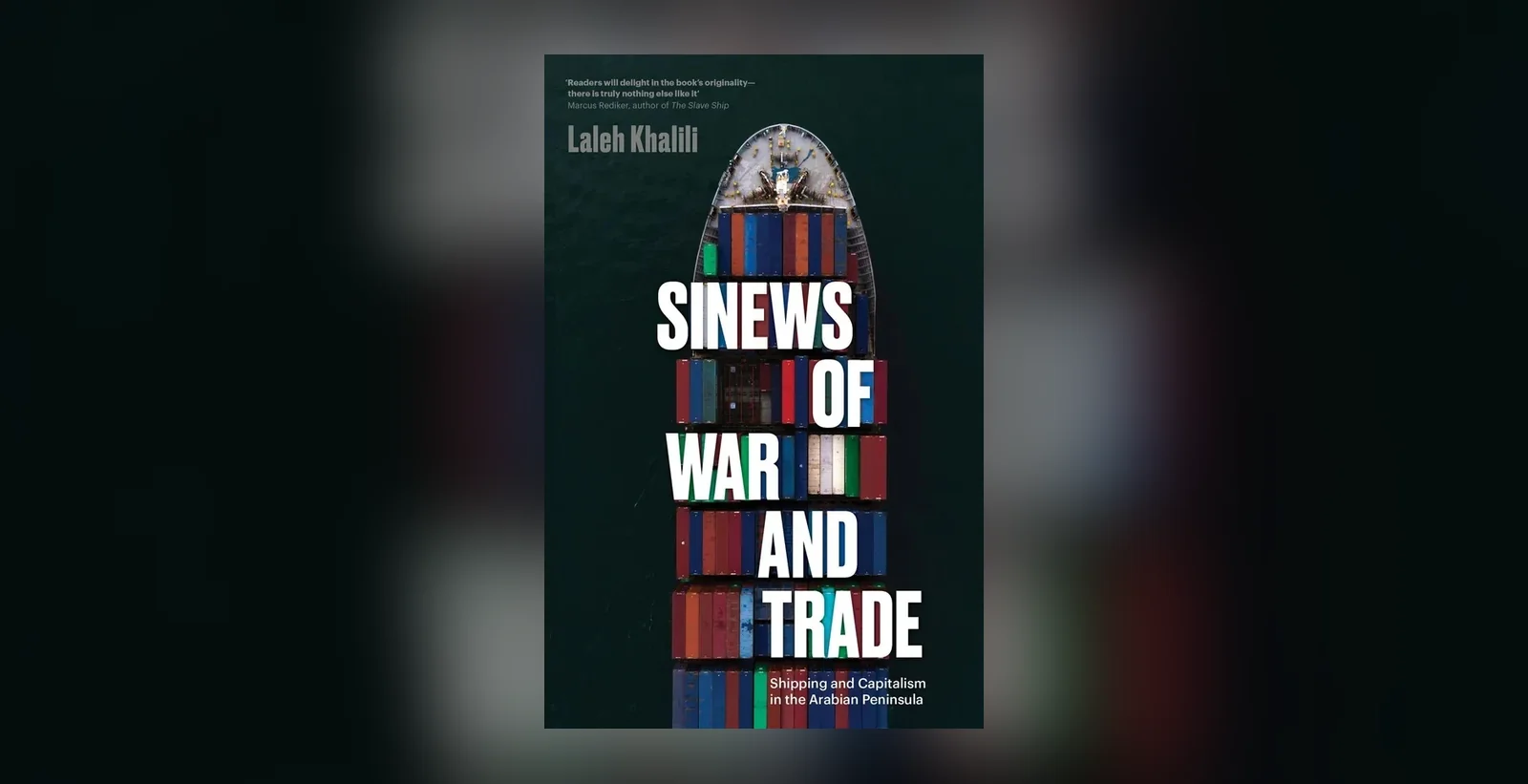
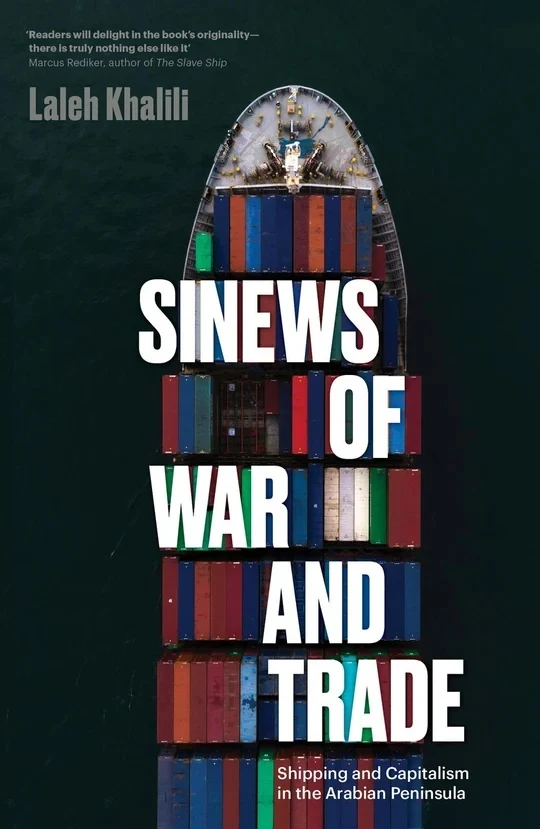
Sinews of War and Trade: Shipping and Capitalism in the Arabian Peninsula
Laleh Khalili
Verso, 2020
There could hardly be a more urgent moment to return to Laleh Khalili’s Sinews of War and Trade: Shipping and Capitalism in the Arabian Peninsula (2020, Verso). The recent war has made the significance of the Strait of Hormuz more visible than ever in headlines. Khalili’s book offers a historically grounded framework for understanding the long entanglement of war, trade, and infrastructure in the region and beyond. Written with narrative clarity and based on a remarkably wide range of archival materials, interviews, and shipboard travel, it reconstructs the histories through which maritime infrastructures have made the Peninsula central to global capitalism. The book is about practices of shipping with a focus on ports, oil, roads, law, labor, and the changing geographies of power.
I read Sinews of War and Trade through the intersection of several fields that shape my own work: critical urban studies, political economy, radical geography, Middle East, Persian Gulf and Iranian studies, and nationalism studies. Khalili’s major contribution is that she shows capitalism not as an abstract, intangible, and elusive system-idea, but as something made materially concrete through the constant production of space, even if she does not name it as such. The book shows how maritime infrastructures produce space by connecting ports to hinterlands, transforming relatively autonomous and disconnected regions into national territories, extending state reach through techno-political projects, and turning law and logistics into everyday instruments of domination. The book’s importance therefore exceeds any single field. It is essential for students and scholars of political economy, Middle East and Gulf studies, international relations, urban studies, labor studies, legal geography, border studies, and critical security studies.
Chapter 1, “Route-Making,” traces how shipping routes are produced through imperial expansion, steamship technologies, telegraph cables, and financial speculation. Routes may appear fluid, yet they “have a solidity, a durability that their marine ephemerality belies” (p. 14). Capitalism, state, and law reorganize the natural materiality of the sea into routes, charts, chokepoints, insurance zones, and financial indices, turning maritime space into a calculable geography of power where “dangerously unrigorous mathematics is essentially a euphemism for wild gambling on a completely imaginary future” (p. 46).
Chapter 2, “Harbour-Making,” demonstrates that ports are shaped by colonial, and nationalist forces. The construction of harbours requires dredging, land reclamation, cement, stone, sand, labor, and the transformation not only of coastlines but also of distant extraction sites. This has created environmentally colonial relations, for instance between Singapore and Myanmar, where riverbed sand has been extracted from many rivers and shipped to Singapore to support its land expansion, leaving Myanmar’s waterways more vulnerable to flooding and bank erosion (p. 83–84). Importantly, harbour-making appears here as a mechanism of territorial expansion: “the construction of Jabal Ali consolidated [Shaikh] Rashid’s claim over the contested borderland” (63–64). Ports, then, do not merely serve the state; they actively help extend its spatial reach, as when the seabed becomes “an extension of the border” (99).
Chapter 3, “Palimpsests of Law and Corporate Sovereigns,” moves to the legal infrastructures of maritime capitalism. Khalili shows that law is not secondary to shipping; it is one of its conditions of possibility. The Onassis-Aramco episode, the invention of the “continental shelf” as a physical-legal category (p. 97–98), the legal fiction of ‘freedom’ of navigation, and the rise of free zones all reveal how legal practice produces space of and for capital. Law mattered: not just to sovereignty, but to capital accumulation (p. 91). This chapter is especially important for scholars of legal geography because it shows that legal categories do not merely describe reality; they actively shape it by creating regimes of ownership, extraction, and accumulation. Law is not a neutral framework but a spatial practice that draws boundaries, erases older landscapes, and turns common spaces into private spaces of domination.
Chapter 4, “Roads and Rails Leading Away,” connects ports to hinterlands. Roads and railways are not merely technical extensions of ports; they draw interiors, peripheries, and oil fields into state space: “The roads brought along the reach of the state” (p. 125). They (re)make centers and peripheries. Roads weave coastal and inland spaces into emerging national territories, partially integrate fragmented polities, and undermine regional autonomies (p. 132). The chapter also shows that road-building is inseparable from the political economy of oil. Aramco’s roads facilitated the export of oil and the importation of materials, but they also created demand for asphalt, expanded the market for gasoline, and helped normalize automobility as a petroleum-based form of movement (p. 129). Road-building is one of the spatial practices through which the nation-state materializes itself.
Chapter 5, “’Mechanic, Merchant, King,’” examines the rise of local capital by analysing the formation of actors who transformed shipping: merchants, bankers, state officials, and engineers. Khalili is particularly strong in showing how private capital and state are not separate spheres but mutually constitutive relations (pp. 152–153). The chapter also helps us frame planning as a multi-modal practice of the state production of space. The chapter also explains that capitalist class formation in the Gulf did not follow the factory-centred industrialisation: “the coming of oil in the 1930s created a new class of Arab capitalists in the Peninsula, especially contractors and construction magnates” (p. 147). Capitalism in the region was formed, to a significant extent, through the production of space itself: ports, roads, company towns, and labor camps became central sites of class formation.
Chapters 6 and 7, on landside labor and shipboard work, bring workers into the center of the analysis. Khalili examines strikes in Aden, racialised labor hierarchies, migrant control, the kafala system (pp. 185–86), deportations, dual-wage systems, and the history of lascars. She writes, “containerisation entailed slashing labour rolls, fragmenting dockworker communities, and spatially isolating the ports” (p. 189). Khalili notes that the “one certain effect” of these technologies is “a further drive towards automation,” one that seeks to purge ports of “those stubbornly resistant elements: workers” (p. 180). This is not only a labor question but also a question of state power. Since the state’s economy depends on ports and oil terminals, “work stoppages are seen not only as a challenge to the employer but also to state security” (p. 212). Shipboard labor is likewise shaped by borders and exclusion: even port visits, which could break “the boredom of being at sea,” were restricted in places such as Khor Fakkan, where the port “does not have a border crossing” and therefore cannot accommodate non-nationals or visa-holding workers (p. 224).
Chapter 8, “The Bounties of War,” traces how wars repeatedly reorganize shipping, finance, oil flows, ports, and one can add, urbanisation, in the region. The Suez crisis, the 1973 war, the Lebanese Civil War, the Iran-Iraq War, the Tanker Wars, the Iraqi invasion of Kuwait, and the Iraq war all produced new routes, new ports, and new military-commercial infrastructures. By the time Suez reopened in 1975, “regional geopolitical power had shifted from Cairo to the Arabian Peninsula” (p. 247). The Lebanese Civil War intensified this shift: after the Beirut docks were burnt down, “most major international firms had moved their headquarters to Dubai and Sharjah” by 1977 (p. 248). The production of Dubai as we know it today was therefore not simply the result of visionary development or natural market growth; it was produced through war, displacement, and the rerouting of capital. The war is not an interruption of trade; it (re)produces the very spaces through which trade circulates.
The central strength of Sinews of War and Trade is its spatio-temporal materialism. Khalili insists on the physical and spatial substances of capitalism: cement, asphalt, sand, stone, dredged seabeds, land, fuel, pipelines, roads, ships, ports, labor camps, free zones, and military bases. Capitalism, therefore, is not represented as an abstract system; it has weight, texture, smell, sound, fuel, heat, pain, and landscape. It is poured as concrete, dredged as seabed, burned as oil, transported as cargo, and guarded as a private property: “to make cement, limestone is baked at around 1,450°C,” that “consumes huge amounts of fuel” and produces “around one tonne of carbon dioxide per tonne of cement” (p. 85). Cement, then, is not merely a building material; it condenses oil, extraction, and atmospheric damage.
This spatial lens also opens a productive conversation with critical urban theory. The book could become even more analytically powerful if read alongside the literature on planetary urbanisation (Brenner and Schmid, 2015). From the perspective of planetary urbanisation, urbanisation is not confined to “a bounded, universally replicable settlement type” but extends through the infrastructural, extractive, logistical, and territorial networks that reproduce urban forms differentially. The ports of Dubai, Jabal Ali, Jubail, Aden, Khor Fakkan, and Fujairah are not merely logistical nodes that are pushed “out of city centers” (p. 78) or “deliberately located far from city centers” (p. 199–200). They are new urban forms, and probably, extensions of the current urban centers, produced through oil, war, migration, and securitization. They show that urbanisation is not limited to cities in the conventional bounded sense. It extends through ports, free zones, roads, labor camps, military bases, and offshore-onshore legal enclaves. Neom makes this argument especially visible. Khalili describes it as “another commercial fantasy and legally variegated enclave” (pp. 118–19). The point becomes sharper when she notes that “ignoring major popular discontent about the deal” Egypt “has also ceded the islands of Tiran and Sanafir” to Saudi Arabia (p. 119). New urban forms in the region thus emerge through what I have called national colonial practices (Torkameh, 2025).
If the postwar American Dream was increasingly organized around suburban homeownership, private automobility, the nuclear family, the Gulf reveals a later and more planetary mutation of that dream. Here, US-Americanisation does not take the form of the classic suburb. It is now a planetary form of suburbanisation. It is reproduced through increasingly privatized spaces of ports, free zones, logistics corridors, oil terminals, refineries, labor camps, and military bases. In this sense, Dubai, Jabal Ali, and the wider port-urbanisation of the Gulf are not simply regional success stories or by-products of war. They are spatial forms through which the American dream (of freedom, consumption, security, and development) is externalised in planetary scale. If, drawing on Dolores Hayden, one argues that the suburban house, the car, and the highway materialized the American Dream domestically, Khalili’s book helps us see how ports and free zones sought to materialize a comparable dream abroad: “Free zones in their various incarnations have become modular technologies for frictionless transfer of capitalist ideology from one place to another” (p. 110). By the 1980s the World Bank made free zones “a condition of structural-adjustment programmes for indebted countries of the global South … to repatriate profits” (pp. 112, 114).
This is where Khalili’s opening epigraph from Heaney becomes unexpectedly generative: “whatever is given / Can always be reimagined.” This applies to the American Dream, too. Read with Hayden, this is not only a critique of the American Dream’s imperial afterlife; it is also an invitation to ask what kinds of spaces would be required to reimagine and redream. Reimagining is not merely a matter of changing ideals; it requires the actual production of different spaces, and perhaps, different scales. The question of housing is particularly important here. The labor camp, the company town, the free zone, the chokepoints, and the port are all part of the same spatio-temporal regime. Khalili does discuss labor camps, but the history of labor could be even more closely tied to the history of dwelling. As Khalili shows, workers do not only labor in ports; they live in segregated, monitored, and often racialized spaces. Such segregation was intensified on construction sites where “loneliness was a condition of work” (pp. 199–200).
Khalili’s analysis invites a further question about nationalism and the nation-state. While Khalili offers a powerful and illuminating analysis of imperialism, the book gives comparatively less attention to one of imperialism’s key political and spatial forms: the nation-state and its accompanying nationalisms. By leaving the nation-state largely unexamined as a historically colonial spatial formation, the book risks placing state-led projects outside the analytical frame of imperialism. Nationalism does not necessarily resist empire; it can reproduce colonial relations on different scales (Torkameh, 2025). Roads, ports, customs regimes, security practices, and military bases often integrate not-yet-national spaces into the state territory while undermining their autonomy. In this sense, colonialism should be understood not only as domination between states but also as a multi-scalar relation of domination between any center and its peripheries.
Read through the literature of radical geography, Khalili’s book allows us to rethink nationalism as a spatial technology tied to the making of the national economy. Here Timothy Mitchell’s concept of economentality can also be useful: the nation appears not only as an imagined community, but as a calculative apparatus organized around the national economy. In Mitchell’s terms, the economy embeds political life in a projected future of national growth and national security. Khalili shows how that future is materially installed through ports, roads, railways, and shipping routes. Mitchell and Khalili allow us to see nationalism as a spatial and economic technology that frames class struggle in national terms and, in doing so, largely neutralises it, separates workers and subaltern groups across borders, and recodes and naturalizes exploitation and coercion as development or national necessity.
This point raises important questions about nationalism and left politics. Khalili shows that communists, nationalists, and anticolonial movements often intersected. Yet the same history also shows how nationalism can weaken class struggle. As Khalili repetitively discusses, national security repeatedly turns labor action into a threat to the state. She shows that the fear of communism and nationalisation helped generate legal regimes designed to protect foreign property, and systems of international arbitration that secured the property of Western investors (pp. 92–93). In this sense, anti-communism did not simply repress left movements; it helped produce the legal geography of global capitalism. Moreover, policies such as Saudisation or Kuwaitisation of labor—as forms of economic nationalism—can intensify the vulnerability of migrant workers. This tension is especially visible when Khalili notes that even “ostensibly radical, cohesive, and militant” dockers’ unions could “stand on the side of US security interests,” as when the SIU1 boycotted a Swedish ship because Sweden had sent supplies to North Vietnam, situated within the communist bloc during the Cold War (pp. 216–17). This confirms that nationalism can override even militant union politics, emptying labor action of its transnational force. Yet Khalili does not fully deal with this tension as a problem for left strategy. Her historical material nevertheless makes it possible to ask how nationalism repeatedly weakens class struggle. These moments suggest the need to rethink left strategy beyond the nation-state form, so that it does not reproduce the very socio-spatial order it seeks to challenge.
This question is particularly important for any reading of the Gulf, the Arabian Peninsula, Iran, and Baluchestan. Khalili’s scattered but suggestive references to Gwadar, Iran, Baluchistan (p. 188), Iranian and Baluchi migrants (p. 194), Parsis (pp. 169–170), and Palestinians (p. 195) reveal a spatiotemporal matrix that long exceeded the borders later imposed by modern states. Gwadar for instance remained under Omani rule “until 1958, when Oman sold Gwadar to Pakistan” (p. 168). Moreover, the fact that Baluchestan appears alongside, rather than simply as part of Iran and Pakistan also matters: it suggests a geography whose historical, maritime, and labor connections cannot be contained by national borders. In this sense, the book opens a path for thinking about pre- and non-national geographies. This aspect could have been brought more fully into the argument, because it would make even clearer how the nation-state tends to obscure older spatial relations. These insights are also useful for resisting nostalgic or nationalist accounts of the region that detach contemporary crises from their longer histories of non-national territories. The same issue matters for the history of race. Khalili gives careful attention to racialised labor, especially in relation to British imperial hierarchies, lascars, migrant workers, labor camps, and dual-wage systems. Yet a fuller account of slavery and its afterlives in the region would have deepened the book’s analysis of race. Racism in the Gulf and the broader Indian Ocean world cannot be understood only through European colonial rule. It also has local, regional, and non-Western histories, including enslavement, anti-Blackness, and the colonisation of peripheralized peoples.
The book’s treatment of war suggests a broader theoretical claim: war is not only destructive; it is also spatially productive. The distinction between war and trade is therefore unstable. What appears after war as development may in fact be the continuation of military logistics by other means. This is one of the book’s most urgent lessons for critical urban studies. This logistical reading of war also allows us to rethink imperialism. An already urbanised imperialism operates through logistical networks, private security companies, extractive investments, border control, armed protection for trade routes, and the production of “frontier” spaces for capital. Erik Prince’s activities illustrate how these infrastructures can cut across the apparent China-US divide. As Khalili says, after providing security for military transport, Prince founded Frontier Services Group in 2012 to supply logistics, insurance, and armed protection to Chinese mining and energy companies operating in East Africa. Listed in Hong Kong and backed partly by the Chinese state-owned Citic Group, the company was designed to provide paramilitary and intelligence-related services in places where Chinese investments required protection. It has also reportedly pursued interests in Pakistan, where China is involved in construction of the port of Gwadar. From this angle, China cannot be understood only as a rival to the United States; it also participates in the expansion of capital, extraction, and securitized logistics across African and Asian spaces. The China–US binary therefore becomes less stable when contractors associated with US military power can also become embedded in the protection of Chinese overseas investments (pp. 263–265).
Such a critical understanding of imperialism can potentially change how we understand the national border. The border is not only a line on a map; it is a career, a market, and a security industry. Consultants, former soldiers, private security firms, and surveillance experts all profit from the multiplication of borders and the further fragmentation of space. Khalili shows this clearly in her account of the US Army Corps of Engineers, whose military construction programme became both “a visible indicator” of US protection and a “conduit for the diffusion of US business expertise” (p. 259). The rise of Agility, a Kuwaiti multinational logistics company, makes the point even sharper: its revenue rose from US$154 million before the US invasion of Iraq to US$6.3 billion in 2008, and by 2010 it had received more than US$8 billion in contracts from the US military (pp. 262–263). Most revealingly, the Kuwaiti government granted Agility a twenty-five-year concession to run “the state’s entire customs business” at all ports of entry (p. 263). Border control thus becomes not only a sovereign function but a privatized industry, one that profits from regulating the movement of people, goods, energy, and money.
Khalili writes about charts, routes, ports, borders, and spatial transformations, but the book would have benefited from visual mapping. Since the argument is so deeply spatial, maps could have helped readers see the changing geography of routes, ports, hinterlands, free zones, labor migration, and military-logistical infrastructures. This is not a major weakness, but it would have made the book’s spatial argument even more visible.
Sinews of War and Trade is a rich, careful, politically relevant, and beautifully narrated book. Its achievement is not only that it tells the history of shipping in the Arabian Peninsula. The book’s final political force lies in its insistence on the erased bodies beneath legal and logistical abstraction. In the history of maritime capitalism, workers often disappear behind contracts, ships, ports, insurance claims, and court cases. Her account makes this point with devastating clarity: “the bodies whose hunger earned profit” were erased from legal history (p. 241). Khalili refuses this disappearing. This quotation from the book captures its ethical and political importance. Sinews of War and Trade asks us to look at the spaces and infrastructures of capitalism, but also at the bodies that build, move, guard, and suffer under them.
References
Blomley, N. K. (1994). Law, Space, and the Geographies of Power. New York: Guilford Press.
Blomley, N. (2023). Territory: New Trajectories in Law. Routledge.
Brenner, N. (Ed.). (2013). Implosions/Explosions: Towards a Study of Planetary Urbanization. Berlin: Jovis.
Brenner, N., & Schmid, C. (2015). Towards a new epistemology of the urban? City, 19(2–3), 151–182.
Hayden, D. (1984/2002). Redesigning the American Dream: Gender, Housing, and Family Life (Rev. ed.). W. W. Norton.
Hayden, D. (2003). Building Suburbia: Green Fields and Urban Growth, 1820–2000. Pantheon Books.
Mitchell, T. (2014). Economentality: How the future entered government. Critical Inquiry, 40(4), 479–507.
Torkameh, A. (2025). The production of Iran as a national state space: A historical geography [Doctoral dissertation, York University]. YorkSpace Institutional Repository
Notes
1. The Seafarers International Union.
About the Authors
Laleh Khalili is a Professor of Gulf Studies at the University of Exeter. With a PhD in political science, her research focuses on violence, war, repression, and the infrastructures of conflict in the Middle East.
Aidin Torkameh holds a PhD in Environmental Studies from York University. He has taught at York University and the University of Toronto and is currently a researcher at Princeton’s Center for Iran and the Persian Gulf.



Comments are closed.